
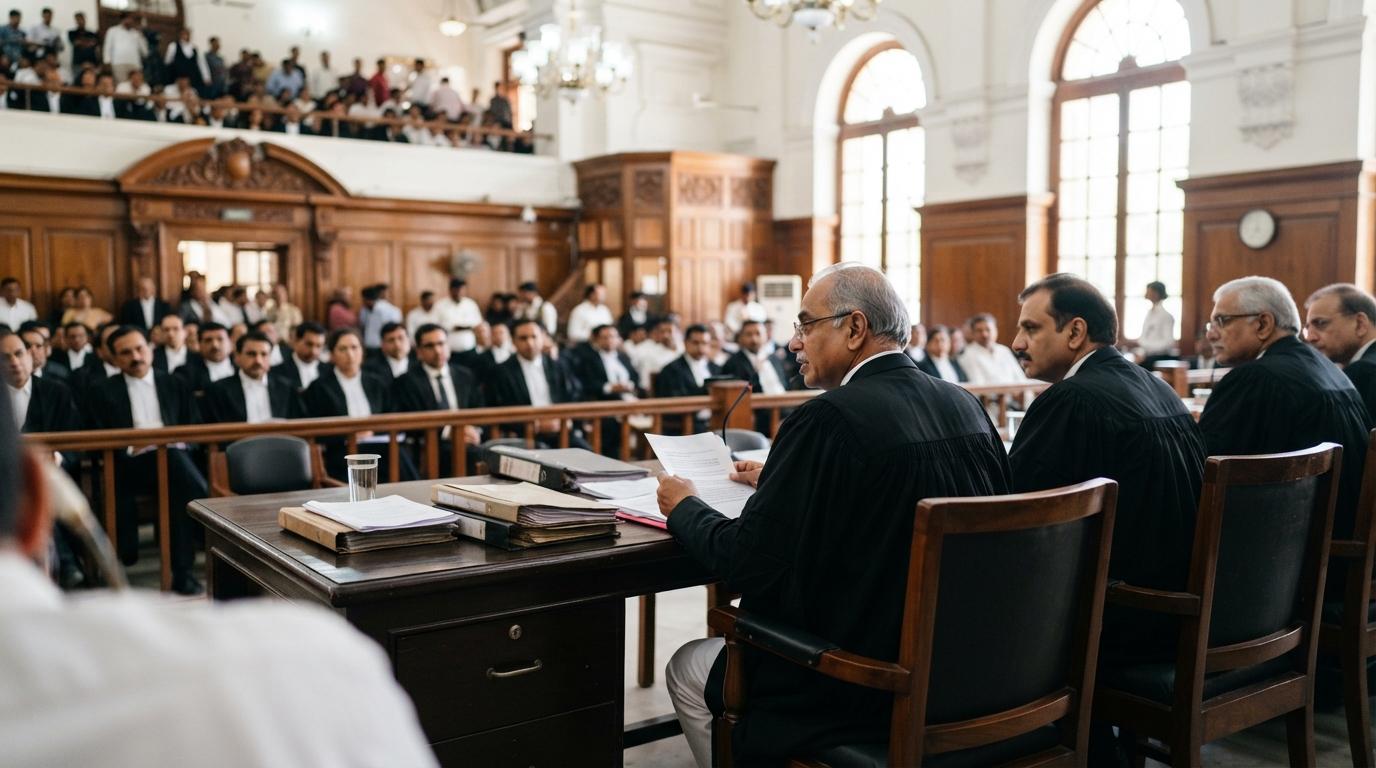
The Supreme Court in India has issued limited notice to the Union of India on a public interest plea over hereditary disorders in children born of consanguineous marriages. The three-judge bench of Chief Justice Surya Kant with Justices Joymalya Bagchi and V Mohana asked the government to examine legislative safeguards or a nationwide awareness drive on genetic risks. The bench said the judiciary could not ban or regulate marital choice and described its role as sensitising the executive.
It was filed by 20-year-old law student Charvi S of the National Law School of India University in Bengaluru. She lives with 40 per cent visual impairment and has been diagnosed with retinitis pigmentosa and cone dystrophy, described as progressive inherited conditions. She said she is the offspring of a first-cousin marriage under traditional custom in her community and attributed her disorders to that union.
She sought scrutiny of the exceptions under the Hindu Marriage Act, 1955 and the Special Marriage Act that permit marriages within prohibited relationships on the ground of custom or usage. The plea argued the exceptions needed review in light of genetic science that could predict avoidable health outcomes. It did not seek criminalisation of existing marriages and instead sought mandatory premarital genetic counselling, disclosure of hereditary risks and voluntary screening in regions where such marriages are common.
Court rules out ban on marital choice
During the hearing, the bench discussed individual autonomy and public health. Justice Bagchi said the court had to move with caution given earlier rulings protecting the right to choose a spouse even where the choice raised medical or social concerns. He referred to an earlier ruling affirming the right to marry a person living with HIV to say courts could not impose restrictions on personal life choices. He said the emphasis should be on enabling persons entering such unions to take an "informed decision". The bench spoke of scientific education in school and college curricula to build a "scientific temper" among young people.
Government asked to weigh legislation, awareness
The bench said it did not intend to issue binding directives and had confined the notice to eliciting the government's view on policy. Medical material cited in the plea claimed such unions raised the likelihood of recessive genetic conditions, congenital malformations and developmental disabilities. Counsel submitted the State owed a duty under inter-generational equity to spread such knowledge in rural and marginalised areas where awareness was low. The government is now expected to state whether it considers legal provisions or public health programmes a viable response.
Comments
Sign in to read the discussion and share your thoughts.
Latest from LawWorld
News
View all- Supreme Court Refers SARFAESI Priority Dispute With Depositor Law To Larger Bench27 Nov 2026
- Supreme Court Rules Mere Objections In Protest Petition Are Not A Complaint27 Nov 2026
- Supreme Court Quashes Bihar Remission To Anand Mohan In IAS Officer Murder Case27 Nov 2026
- Supreme Court Acquits Rape Accused For Lack Of Medical Evidence27 Nov 2026
- Supreme Court Mandates Separate Hexagonal Warnings For Fat, Sugar, Salt26 Nov 2026