
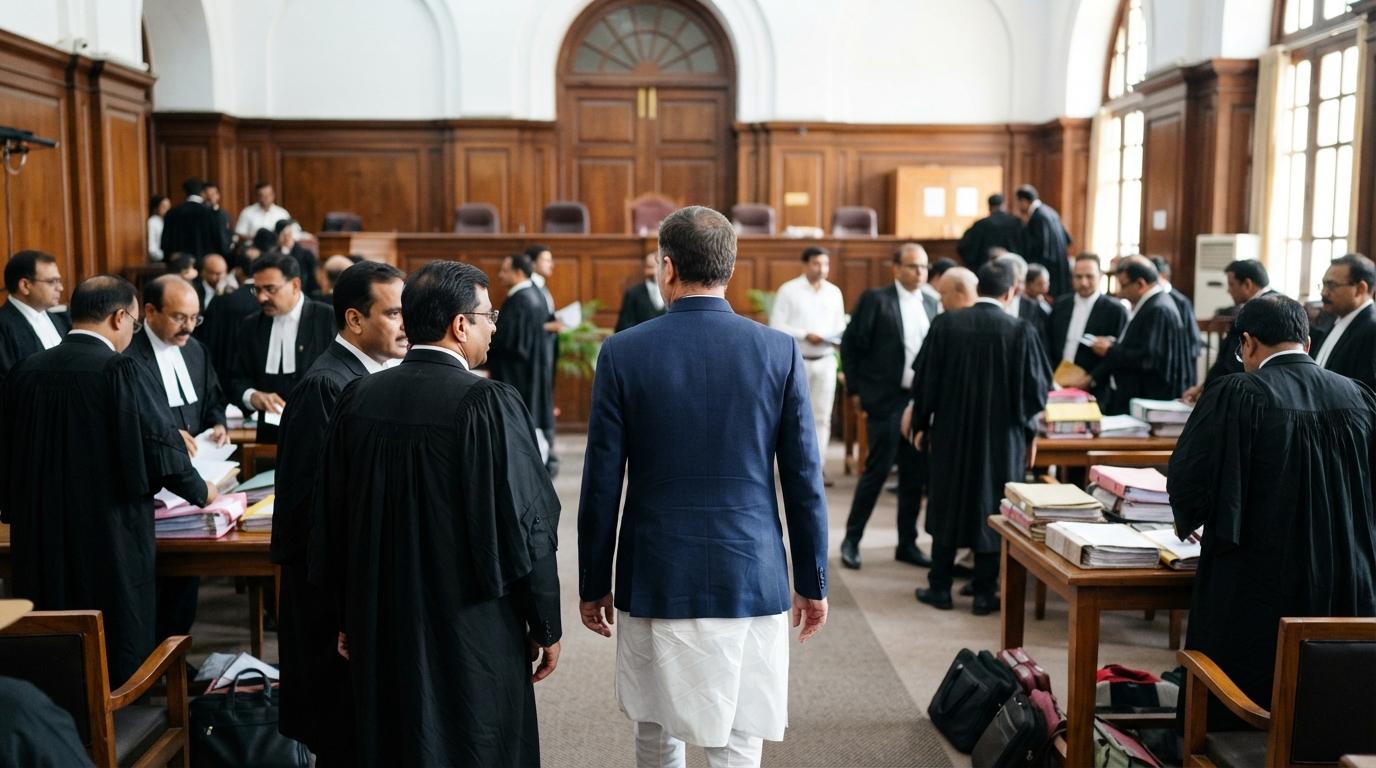
The Supreme Court on Wednesday, November 25, 2026 set aside orders passed by the Allahabad High Court directing the Central Bureau of Investigation and the Enforcement Directorate to verify allegations of disproportionate assets against Leader of the Opposition in the Lok Sabha Rahul Gandhi. A three-judge bench of Chief Justice Surya Kant and Justices Joymalya Bagchi and V. Mohana disposed of Gandhi's special leave petitions arising from Diary No. 47728 of 2026 against S. Vignesh Shishir and others. The bench remitted the writ petition filed by Shishir to the High Court for fresh consideration from the threshold on all questions including the maintainability of PIL. It directed that Gandhi be impleaded as a formal respondent in that writ petition and heard before any adverse direction is issued. It said it expressed no view on the merits of the allegations.
Before that order, the Court had asked the High Court not to proceed with the case and had asked the CBI and the ED not to file any report under the High Court's directions against Gandhi. That interim protection halted the verification exercise while Gandhi's appeal remained pending.
High Court orders in May and July
The Lucknow Bench of the High Court had in May and July directed the two central agencies to probe the complaint relating to Gandhi's assets. The High Court had noted that the affidavit filed by the CBI was not in compliance with its earlier order and did not adequately explain the progress made on the complaint submitted against Gandhi. It had directed the joint director or the head of the zone concerned at the CBI's Anti-Corruption division headquarters in New Delhi to personally file a fresh affidavit detailing the progress made in the matter.
Gandhi, represented by advocate Prasanna S., challenged the interim orders as a green signal for a fishing expedition against him. He submitted that the orders were passed without making him a party or hearing him first. He said the High Court did not refer to the foundational material or provide reasons for directing what he called a roving inquiry. He said the proceedings were marked by in-chamber hearings with documents and pleadings kept under wraps in sealed covers. He termed the series of directions among the rarest instances of a constitutional court acting contrary to first principles and described them as outside the settled rules of law.
The complainant, who appeared as respondent in Gandhi's appeal, said an accused does not have an inherent right to be heard at the pre-FIR stage. Justice Bagchi pointed out that under the Bharatiya Nagarik Suraksha Sanhita the scope for the accused to be heard has been expanded. Chief Justice Kant said, "We are on the basic fundamentals of hearing. We will not make any observations on the merits of the case."
He submitted that Shishir is a member of the Bharatiya Janata Party and the Rashtriya Swayamsevak Sangh and had filed multiple complaints and public interest litigation against him in the past. Those earlier actions included allegations of foreign citizenship and a plea alleging dual citizenship, besides the present complaint of holding assets disproportionate to known sources of income. He said repeated proceedings by the same motivated individual on unsubstantiated allegations showed a pattern of persistent and vexatious litigation. The dispute will now be heard afresh by the High Court with Gandhi added as a party.
Comments
Sign in to read the discussion and share your thoughts.
Latest from LawWorld
News
View all- Supreme Court Refers SARFAESI Priority Dispute With Depositor Law To Larger Bench27 Nov 2026
- Supreme Court Rules Mere Objections In Protest Petition Are Not A Complaint27 Nov 2026
- Supreme Court Quashes Bihar Remission To Anand Mohan In IAS Officer Murder Case27 Nov 2026
- Supreme Court Acquits Rape Accused For Lack Of Medical Evidence27 Nov 2026
- Supreme Court Mandates Separate Hexagonal Warnings For Fat, Sugar, Salt26 Nov 2026