
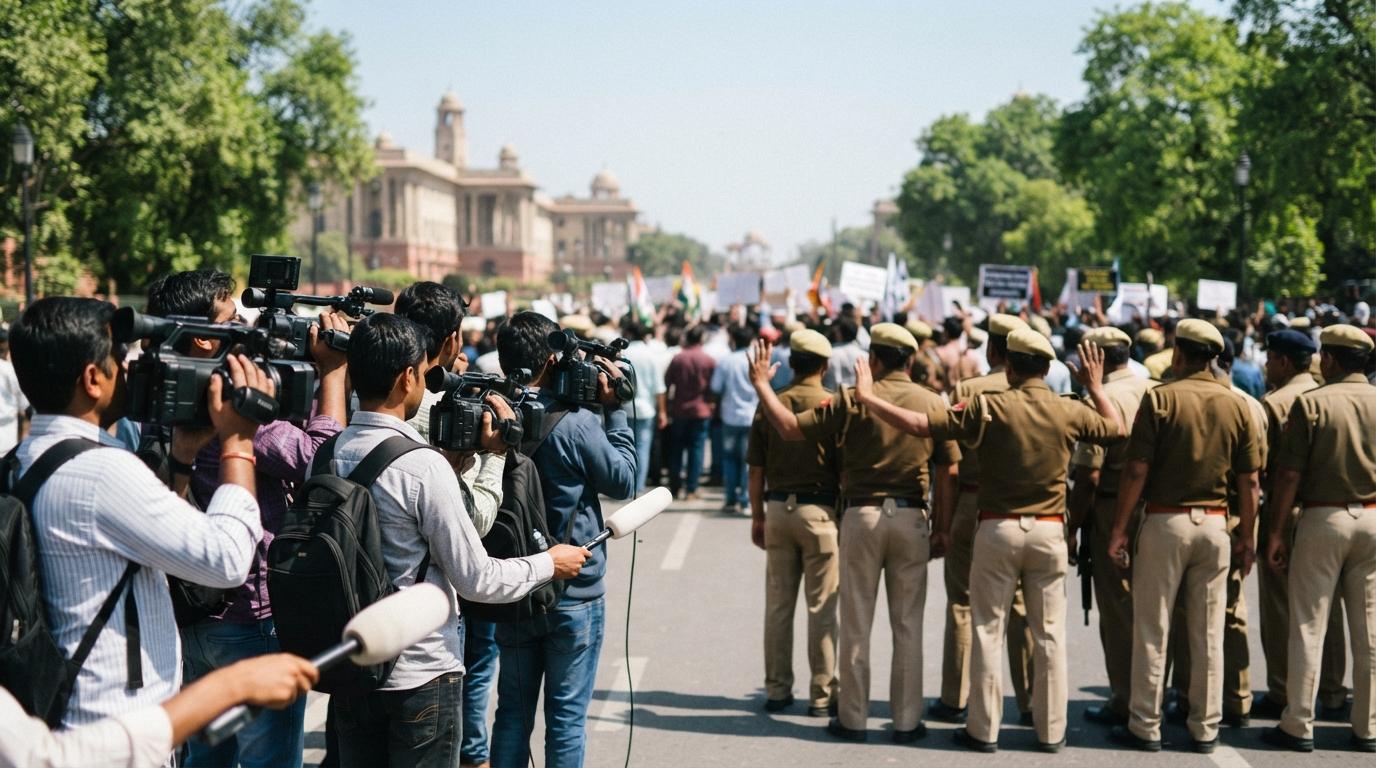
The Supreme Court on Thursday sent the complaints of seven journalists who said Delhi Police detained and manhandled them while they covered the October protests seeking Chief Election Commissioner Gyanesh Kumar's resignation to the Empowered Inquiry Committee for examination.
Chief Justice of India Surya Kant, Justice Joymalya Bagchi and Justice V. Mohana passed the direction while hearing petitions by the Network of Women in Media, India, Free Speech Collective, Delhi Union of Journalists and the Kerala Union of Working Journalists.
The seven are Suhail Muhammed and V.S. Rahul of 24 News, Sajin of Asianet News, Roshni Rajan of Reporter TV, Vishnuprasad of Mathrubhumi, Miji P. Jose of Manorama News and independent reporter Farasana.
Disposing of the Kerala Union of Working Journalists plea filed for them without any opinion on the merits, the Bench asked the Committee to examine each allegation of police excess separately.
Court asks who is a journalist
Justice Bagchi said self-proclaimed journalists may not enjoy the same protection as accredited journalists when covering protests.
Under any Standard Operating Procedure, he said, the graded police response would depend on the status and credentials of the person claiming to be a journalist. A person who attends a protest as a journalist, he said, should carry appropriate identification.
"Even if we lay down the Standard Operating Procedures, the graded response of the law enforcement agency would also depend upon the status and credentials of the person claiming to be a journalist. In this regard, if you are going there as a journalist, you should carry appropriate identification. If you are a journalist working with a newspaper in the print media, you would be covered by the Press Council accreditation framework.....These are the aspects we will have to consider. We now have atomised individuals claiming to be journalists. Self-proclaimed journalists may not have the same protection as accredited journalists," Justice Bagchi said.
Accreditation or registration, he said, could establish the credentials of reporters working with print publications, television channels and online platforms.
Solicitor General Tushar Mehta told the Bench that anyone could start a YouTube channel and use a name resembling an established newspaper to claim journalistic status, and such status could not be self-certified.
According to the petitioners, calling those present at the site reel-makers and content creators was an afterthought and could not have been used on the spot to restrain or remove those covering the event.
In an earlier affidavit, Delhi Police had said it had not knowingly obstructed journalists from performing their duties and that social media influencers, content creators and reel-makers were not covered by the Court's October 11 direction that lawyers, journalists and other professionals should not be hindered in the discharge of their professional duties.
The Bench also questioned whether journalists have any special privilege over law enforcement agencies while covering protests and whether forcible removal of a journalist from a protest site would amount to custody with constitutional consequences.
Press freedom, the Bench said, would have to be balanced with the maintenance of public order.
Each file will now go before the Empowered Inquiry Committee for scrutiny.
Comments
Sign in to read the discussion and share your thoughts.
Latest from LawWorld
News
View all- Supreme Court Refers SARFAESI Priority Dispute With Depositor Law To Larger Bench27 Nov 2026
- Supreme Court Rules Mere Objections In Protest Petition Are Not A Complaint27 Nov 2026
- Supreme Court Quashes Bihar Remission To Anand Mohan In IAS Officer Murder Case27 Nov 2026
- Supreme Court Acquits Rape Accused For Lack Of Medical Evidence27 Nov 2026
- Supreme Court Mandates Separate Hexagonal Warnings For Fat, Sugar, Salt26 Nov 2026