
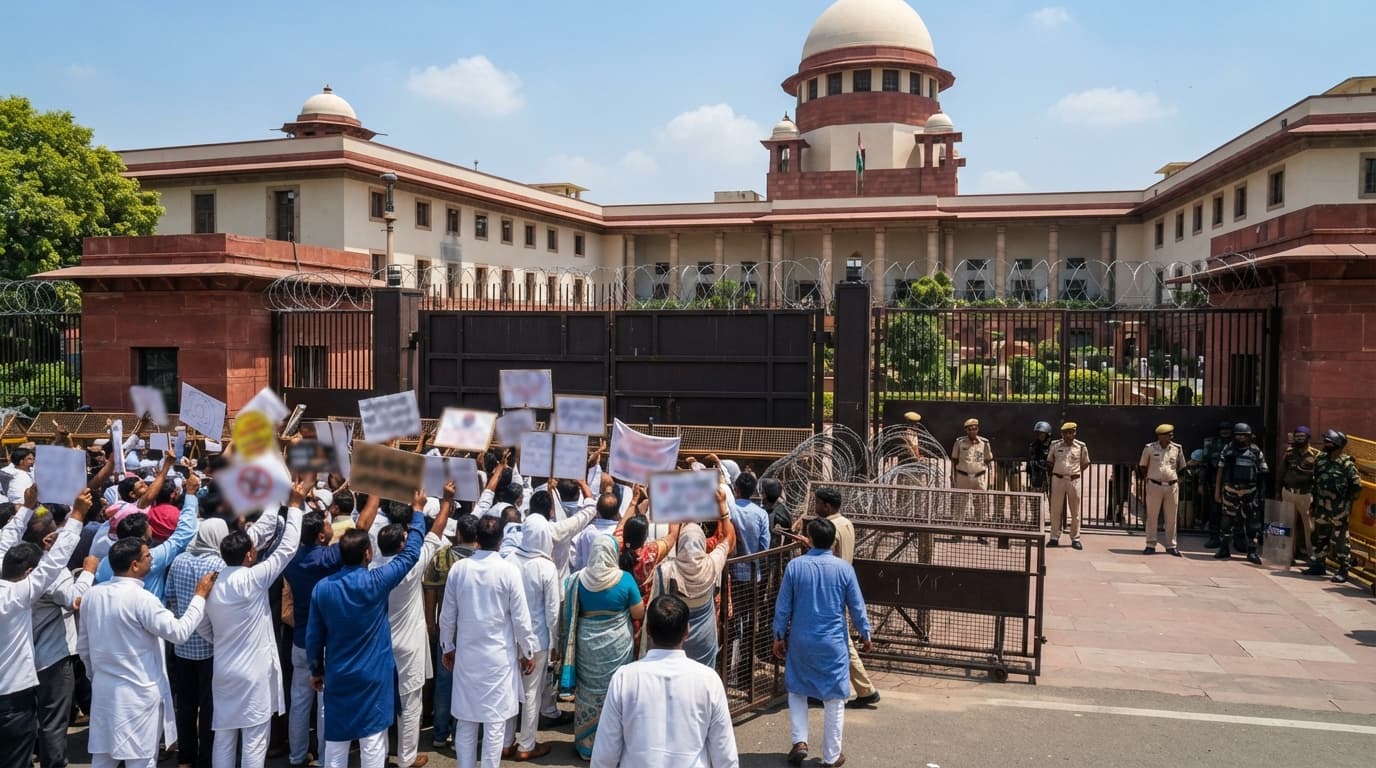
The Supreme Court issued notice to the Union government, the Congress party, Rahul Gandhi, Mallikarjun Kharge, the Kerala Pradesh Congress Committee, Mahua Moitra, and Akhilesh Yadav on a petition filed by four advocates seeking to establish a uniform framework regulating political processions and demonstrations around the Supreme Court and High Courts. Chief Justice Surya Kant and Justice Joymalya Bagchi heard the matter. The bench declined to issue a contempt notice at this stage, saying it will decide after reviewing responses from the parties.
The petition requests an absolute prohibition on political protests inside court premises and calls for preservation of CCTV footage, visitor and access-control records, and security reports related to a march towards the Supreme Court on October 12, 2026. The plea seeks to regulate political activity within the precincts of the nation's highest court and its subordinate benches, raising questions about the balance between democratic expression and the sanctity of judicial spaces.
What the advocates are asking for
The four advocates have sought comprehensive guidelines that would apply uniformly across the Supreme Court and all High Courts in India. Their submission focuses on preventing political processions and demonstrations within court premises, arguing that such activities may compromise the dignity and independence of the judiciary. The petition explicitly requests the court to direct preservation of security-related documentation from the October 12 march.
The march took place during a period of heightened political activity in Delhi, with multiple demonstrations occurring on October 10, 11, and 12, 2026. The request to preserve CCTV footage and security records suggests the petitioners wish to maintain a record of the events that prompted their legal challenge.
Bench takes measured approach
The bench declined to initiate contempt proceedings against the respondents at this stage. This reflects established judicial practice: the court will hear the other side before making any determination on such a serious matter. Contempt proceedings carry significant consequences, and the bench appears to have determined that the proper course is to gather all relevant information and submissions before proceeding.
Political leaders named as respondents
The inclusion of specific political leaders and parties as respondents indicates the petitioners view the October 12 march as a political action requiring responses from those who organized or participated in it. The Congress party has been made a party. Individual leaders including Rahul Gandhi and Mallikarjun Kharge have been named, along with Mahua Moitra and Akhilesh Yadav, suggesting their involvement or leadership role in the demonstration.
The Union government has also been made a respondent, likely because questions about security arrangements, police conduct, and the regulation of demonstrations on court premises fall within its purview.
Backdrop of October protests
The October 12 march towards the Supreme Court occurred within a larger context of political mobilization in Delhi. Multiple petitions have been filed in the Supreme Court by individuals detained during protests on October 10, 11, and 12, alleging police excesses including illegal detention, physical assault, and manhandling of protesters and journalists. These petitions raise concerns about police conduct during demonstrations against the Election Commission of India's Special Intensive Revision of electoral rolls.
The Lawyers Association for Constitution and the Network of Women in Media also filed petitions addressing police action against protesters. At least 15 separate petitions have been filed by detainees seeking an independent inquiry into police conduct, preservation of CCTV and bodycam footage, and the return of seized belongings. This backdrop of allegations regarding police action adds complexity to the current petition, as the court must consider not only the conduct of protesters but also the conduct of state authorities.
Judicial dignity versus democratic rights
The petition raises a fundamental tension in constitutional law: the court's need to maintain its dignity and independence versus citizens' right to petition and protest. The petition seeks an absolute prohibition on political protests inside court premises, a position that courts have previously addressed through various mechanisms including security protocols, restricted access zones, and time-specific restrictions.
The Supreme Court's decision to issue notice rather than immediately accede to the petition suggests the bench recognizes this tension. The court will need to consider whether an absolute ban is necessary or whether more calibrated measures might address legitimate security and dignity concerns while preserving constitutional rights.
Evidence preservation
The petition's specific request for preservation of CCTV footage, visitor records, access-control logs, and security reports from October 12 indicates an evidentiary dimension to the case. The petitioners appear concerned that documentary evidence of the march might be lost or destroyed. This request also suggests the petitioners may intend to rely on video evidence and security data to establish facts about what occurred during the demonstration.
What comes next
The Supreme Court has now called upon all respondents to file their responses to the petition. The Union, the Congress party, the named political leaders, and other respondents will have an opportunity to present their positions. They may contest the factual allegations in the petition, argue that the requested relief is inappropriate, or propose alternative measures.
Once responses are filed, the court will review them and determine whether to issue a contempt notice, whether to grant the relief sought in the petition, or whether to take some other course. The bench may also seek further submissions from the petitioners or other interested parties. The timeline for these proceedings remains within the court's discretion.
Comments
Sign in to read the discussion and share your thoughts.
Latest from LawWorld
News
View all- Karnataka High Court Upholds Diageo's Priority in Vijay Mallya UBL Shares Dispute, Sets Aside DRT Orders16 Oct 2026
- Karnataka High Court Upholds BDA Land Acquisition, Issues Strict Compliance Warning to Authority16 Oct 2026
- Karnataka High Court Quashes Aviation Safety Communications for Non-Compliance with Aircraft Rules Procedure16 Oct 2026
- Karnataka High Court Upholds Finality of K-RERA Orders, Clears Path for Property Attachment in Homebuyer Dues Recovery16 Oct 2026
- Karnataka High Court Rules Against Sub-Delegation of Temple Mismanagement Inquiry Authority16 Oct 2026
Articles
View all- Supreme Court Refers DPDP Act Constitutional Challenge to Five-Judge Bench: RTI vs. Privacy Rights at Stake12 Oct 2026
- Supreme Court Disposes PIL on Doxxing and Deepfakes; Directs Union Ministries to Implement Remedial Measures8 Oct 2026
- Supreme Court Issues Notice on Constitutional Challenge to GST Input Tax Credit Denial Provision7 Oct 2026