
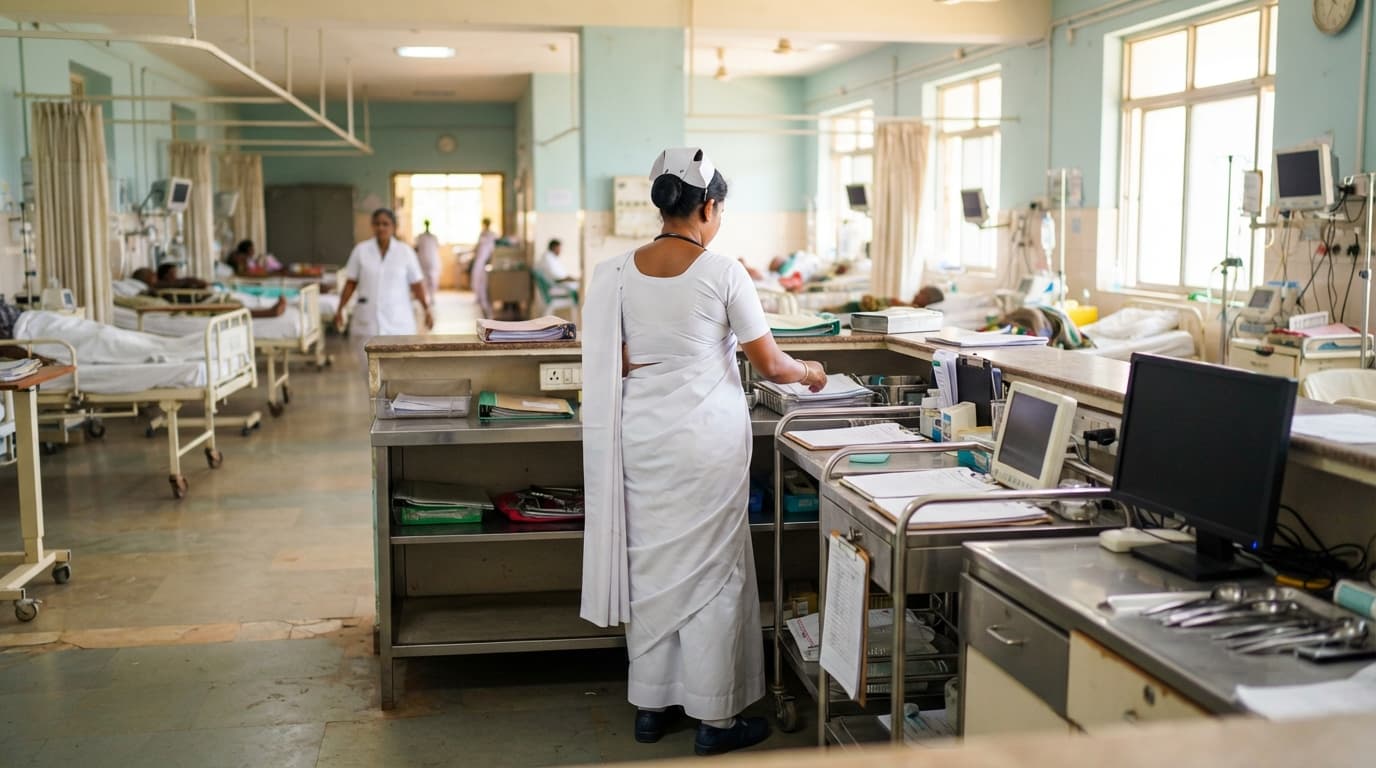
Karnataka High Court Demands State Explain 16-Year Salary Delay for KIMS Nurse
A Division Bench of the Karnataka High Court comprising Justice M. Nagaprasanna and Justice Hema Kulkarni has issued a show-cause notice to the State government demanding an explanation for why a staff nurse at the Karnataka Institute of Medical Sciences (KIMS), Hubballi, has received only a consolidated monthly salary of ₹10,000 for nearly 16 years. The court's order addresses a systemic failure by authorities to issue a caste validity certificate to the nurse, Anasuya P. Koti, despite previous court orders dating back to 2011.
The bench expressed serious concern over the prolonged delay, which has resulted in substantial financial loss to the nurse. According to the court's direction, the State must provide a detailed explanation regarding the salary loss suffered by Ms. Koti and justify why recovery should not be made from the responsible officials. The bench also called for the State to show cause as to why exemplary costs should not be imposed for the extended period of non-compliance with judicial orders.
The missing certificate
Ms. Koti, who belongs to the Moger caste, has been employed as a staff nurse at KIMS Hubballi. The core issue stems from the failure of the institution and the State authorities to process and issue her caste validity certificate, a document essential for determining her correct salary scale and other employment benefits. A court order issued in 2011 mandated the issuance of this certificate, yet the administrative machinery remained inert, leaving the nurse in financial disadvantage for over a decade and a half.
The failure to issue a caste validity certificate has prevented Ms. Koti from accessing the salary structure and benefits to which she may be entitled under applicable government rules and reservation policies. Over 16 years, the cumulative effect of receiving a substantially lower monthly salary represents a significant economic deprivation that has likely affected her financial security, career progression, and access to social security benefits tied to her employment status.
Court signals accountability
By issuing a show-cause notice, the court has signaled its intent to hold the State accountable not merely for the administrative oversight but potentially for the financial consequences of that oversight. The reference to exemplary costs is particularly noteworthy, as it suggests the court may consider imposing penalties beyond the mere recovery of lost salary, thereby sending a message about the seriousness of non-compliance with judicial orders.
This case reflects a recurring problem within Indian public administration: the slow pace at which routine administrative tasks are completed, particularly those involving caste verification and employment documentation. While caste validity certificates are procedural documents, their issuance is often delayed by bureaucratic inertia, inadequate staffing, or administrative disorganization. When such delays occur in the context of a court order, they represent a failure not only of the administrative system but also of respect for judicial authority.
The court's decision to seek an explanation from responsible officials opens the possibility of personal accountability. If the bench determines that specific officials were negligent or deliberately obstructive in their duties, it may recommend disciplinary action or direct recovery of the financial loss from those individuals rather than from the State exchequer. This approach reflects an emerging judicial willingness to enforce personal responsibility for systemic failures.
Path to redress
For Ms. Koti, the order provides a potential pathway to financial redress. If the court accepts that the salary loss was unlawful and causally linked to the State's failure to issue the caste validity certificate, she may recover the difference between the salary she received and the salary she should have received over the 16-year period. Calculating this amount will require determining what her correct salary scale should have been and applying it retrospectively, a process that may itself involve technical and administrative complexities.
The case raises questions about the enforcement of court orders in employment disputes. When a court orders an administrative action—such as the issuance of a certificate—and that order is not complied with for years, the remedies available to the aggrieved party are often limited. The show-cause notice issued by this bench suggests a more proactive approach: rather than waiting for the affected party to file a contempt petition or a fresh writ, the court is itself investigating the reasons for non-compliance and preparing to impose consequences.
State governments in India often face significant backlogs in administrative tasks, and KIMS Hubballi, as a government medical institution, operates within the broader constraints of public sector administration. However, these systemic challenges do not excuse non-compliance with court orders. The bench's action sends a clear signal that judicial orders regarding employee benefits and administrative procedures must be treated as binding and urgent, not as suggestions to be addressed when administrative convenience permits.
The court's reference to the 2011 order is significant. It demonstrates that this is not a case of a recent oversight but of a prolonged institutional failure spanning more than a decade. The fact that a court order from 2011 remained unexecuted until 2026 suggests either a serious breakdown in the administrative chain of command or a deliberate disregard for the judicial directive. Either scenario is troubling and warrants the court's intervention.
The bench has now placed the ball firmly in the State's court. The government must respond to the show-cause notice with a detailed account of why the caste validity certificate was not issued despite the 2011 order, what steps have been taken since then, and why Ms. Koti should not receive full financial compensation. The State's response will likely determine the extent of the remedy and whether disciplinary or punitive measures will be pursued against responsible officials.
Public sector employees who depend on administrative processes for their economic security face particular vulnerability. A single procedural failure, when compounded by years of bureaucratic inaction, can result in substantial and quantifiable harm. The Karnataka High Court's intervention offers some prospect of remedy, but it also exposes the systemic weaknesses in administrative accountability that allow such situations to persist for so long.
The court's next step will likely be to hear the State's response to the show-cause notice and, depending on the adequacy of that response, to pass final orders on the quantum of salary recovery and the imposition of costs. Ms. Koti's case will serve as a test of the court's willingness to enforce not only the substantive rights of public employees but also to hold the State accountable for the financial consequences of administrative negligence.
Comments
Sign in to read the discussion and share your thoughts.
Latest from LawWorld
News
View all- Karnataka High Court Upholds Diageo's Priority in Vijay Mallya UBL Shares Dispute, Sets Aside DRT Orders16 Oct 2026
- Karnataka High Court Upholds BDA Land Acquisition, Issues Strict Compliance Warning to Authority16 Oct 2026
- Karnataka High Court Quashes Aviation Safety Communications for Non-Compliance with Aircraft Rules Procedure16 Oct 2026
- Karnataka High Court Upholds Finality of K-RERA Orders, Clears Path for Property Attachment in Homebuyer Dues Recovery16 Oct 2026
- Karnataka High Court Rules Against Sub-Delegation of Temple Mismanagement Inquiry Authority16 Oct 2026
Articles
View all- Supreme Court Refers DPDP Act Constitutional Challenge to Five-Judge Bench: RTI vs. Privacy Rights at Stake12 Oct 2026
- Supreme Court Disposes PIL on Doxxing and Deepfakes; Directs Union Ministries to Implement Remedial Measures8 Oct 2026
- Supreme Court Issues Notice on Constitutional Challenge to GST Input Tax Credit Denial Provision7 Oct 2026