
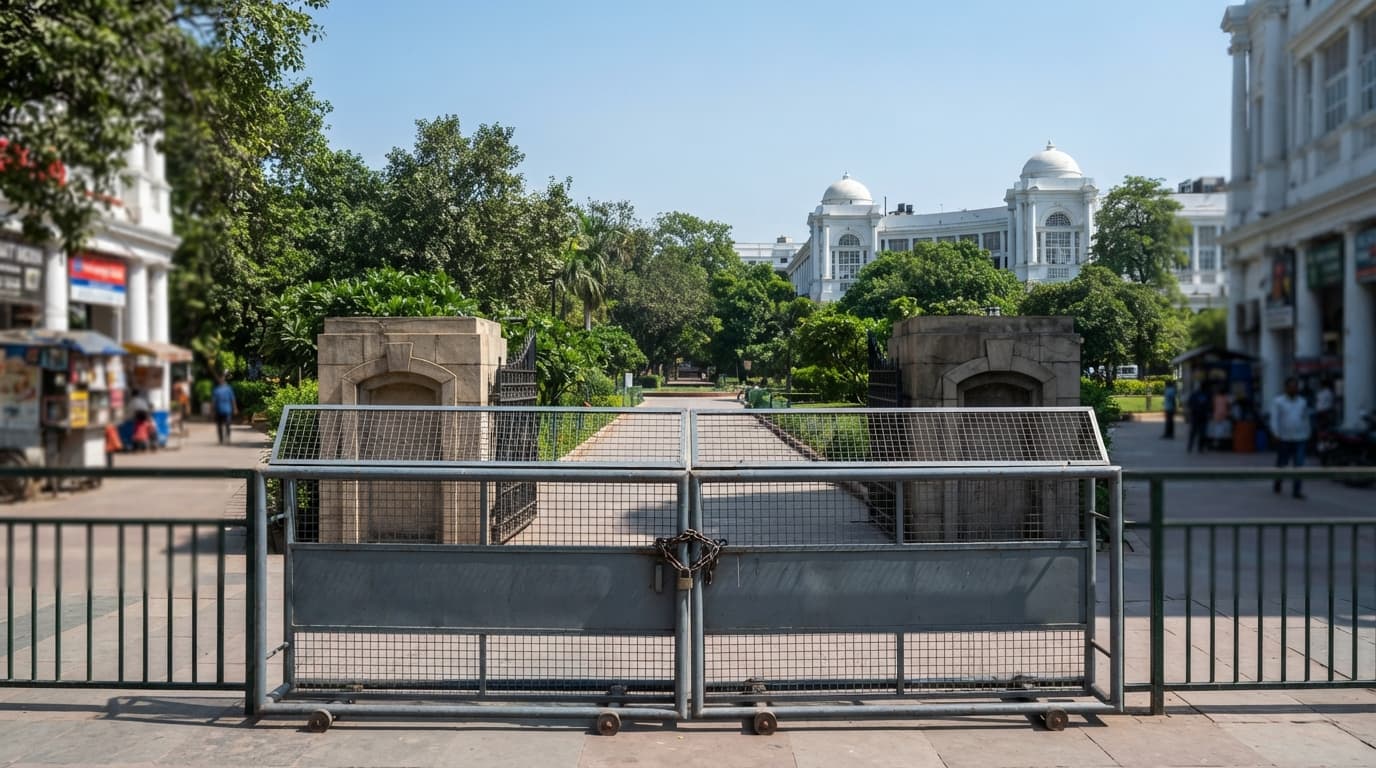
The Supreme Court on Friday declined an urgent hearing on a plea challenging the New Delhi Municipal Council's order to shut down Central Park at Connaught Place ahead of a political march. A bench comprising Chief Justice of India Surya Kant and Justice Joymalya Bagchi heard the matter but chose not to grant emergency relief, instead indicating that the case might be listed for hearing on October 26 or 27.
The plea was filed in response to the NDMC's directions to close the park, issued late Thursday night ahead of the Cockroach Janta Party's "Lehra Do Tiranga" march. The closure order prompted concerns from those who rely on the park for commercial and recreational purposes, particularly small shopkeepers operating in the area who feared business disruption.
Bench Weighs Competing Interests
During the hearing, the bench acknowledged the complex nature of the matter, recognising that multiple interests were at stake. Chief Justice Kant and Justice Bagchi noted the interconnected issues involving the right to protest, the livelihood of small shopkeepers dependent on foot traffic in and around the park, and the maintenance of law and order. Rather than treating these as separate concerns, the court suggested they required careful consideration together.
Justice Bagchi made an important observation during the proceedings, stating that the court could exercise its constitutional jurisdiction if the situation resulted in measurable business losses. This remark signalled the bench's awareness that the park closure might cause financial harm to traders and vendors, though it stopped short of intervening immediately.
The bench expressed hope that "better sense will prevail" among all concerned parties. Chief Justice Kant's comment reflected the court's expectation that the NDMC, the organisers of the march, and other parties involved might find a way to accommodate both the right to protest and the interests of those earning their livelihood in the area.
Why the Urgent Hearing Was Declined
The refusal to grant urgent relief does not mean the court dismissed the plea entirely. Instead, the bench's decision to defer the matter to late October suggests the court wanted to allow time for the situation to develop and for the parties to explore alternatives before judicial intervention became necessary. Urgent hearings are typically reserved for cases where irreparable harm would occur without immediate court action, and the bench may have concluded that the circumstances did not meet that threshold at that moment.
The NDMC's order had been issued with short notice, giving limited time for affected parties to seek legal remedies. The closure of a public park, particularly one in a commercial hub like Connaught Place, affects not only shopkeepers but also the general public who use the space for recreation and social gatherings. The timing of the closure—announced late Thursday night for what appeared to be an imminent event—raised questions about procedural fairness and whether adequate notice had been given to those who would be affected.
Public Spaces and Competing Rights
This case sits at the intersection of two fundamental rights: the constitutional right to assemble and protest, and the right to livelihood and property. India's Constitution protects the right to peaceful assembly under Article 19, but this right is not absolute and can be restricted in the interests of public order, sovereignty, and integrity of the state. Simultaneously, Articles 19 and 21 protect the right to carry on any profession or occupation and the right to life with dignity, which includes the ability to earn a living.
The Supreme Court has previously grappled with balancing these rights in cases involving public demonstrations, road closures, and restrictions on commercial activity. The bench's approach in this instance—acknowledging the legitimacy of both the right to protest and the right to livelihood, rather than prioritising one over the other—reflects the court's understanding that such matters require nuanced handling.
The fact that the closure affected small shopkeepers added a layer of social concern. Unlike large commercial establishments that might absorb temporary losses, small traders often operate on thin margins and depend on daily foot traffic. A sudden closure of a major public space could translate into direct financial loss for vulnerable segments of the trading community.
The October 26-27 Timeline
By indicating that the plea might be listed on October 26 or 27, the bench gave itself and the parties a window of time. This timeline suggests that the court wanted to see how events unfolded and whether the NDMC might reconsider its order or whether the march organisers and municipal authorities could reach a compromise. It also allowed the petitioner time to gather evidence of potential business losses or other concrete harms, should such evidence be necessary for the court's decision.
The Supreme Court's cause list system allows for flexibility in scheduling matters based on urgency and availability of the bench. By not fixing an immediate hearing but leaving the door open for listing within days, the court balanced the petitioner's interest in swift relief against its own institutional capacity and the need for adequate preparation.
Procedural and Substantive Questions Ahead
When the matter is eventually heard, several questions will likely arise. First, whether the NDMC had followed proper procedure in issuing the closure order, including whether it had given adequate notice and opportunity to be heard to affected parties. Second, whether less restrictive alternatives existed, such as allowing the park to remain open while implementing enhanced security measures during the march. Third, whether the closure was proportionate to the stated objective of maintaining law and order.
The Supreme Court has consistently held that restrictions on fundamental rights must be necessary, proportionate, and not wider than required to achieve the legitimate aim. If the petitioner can demonstrate that the park closure was broader than necessary or that the NDMC had not considered alternative measures, the court might be inclined to direct a modification of the order.
What Comes Next
Until the matter is listed for full hearing, the NDMC's closure order remains in effect. Small shopkeepers and others dependent on access to Central Park must comply with the closure or seek interim relief through other means. The petitioner has the option of approaching the court again if circumstances change materially or if the closure extends beyond what was initially announced.
The Supreme Court's decision to defer the urgent hearing, coupled with its stated hope that better sense would prevail, reflects an institutional preference for resolving such matters through dialogue and negotiation where possible. However, the court's willingness to hear the matter on October 26 or 27 signals that if no resolution is reached, it stands ready to intervene and adjudicate the competing claims.
Comments
Sign in to read the discussion and share your thoughts.
Latest from LawWorld
News
View all- Karnataka Government to Challenge High Court's 56% Reservation Ruling in Supreme Court16 Oct 2026
- Karnataka High Court Mandates Hearing Before Drug License Suspension Under Drugs and Cosmetics Rules16 Oct 2026
- Karnataka High Court Rules Unsubstantiated Mental Disorder Claims Constitute Legal Cruelty in Matrimonial Disputes16 Oct 2026
- Supreme Court Agrees to Hear Application Alleging Rahul Gandhi Pushed Pregnant Journalist in Court Premises16 Oct 2026
- Supreme Court Provisionally Entertains Sanjay Raut's Petition, Seeks Explanation for Remarks Against Judiciary16 Oct 2026
Articles
View all- Supreme Court Refers DPDP Act Constitutional Challenge to Five-Judge Bench: RTI vs. Privacy Rights at Stake12 Oct 2026
- Supreme Court Disposes PIL on Doxxing and Deepfakes; Directs Union Ministries to Implement Remedial Measures8 Oct 2026
- Supreme Court Issues Notice on Constitutional Challenge to GST Input Tax Credit Denial Provision7 Oct 2026