
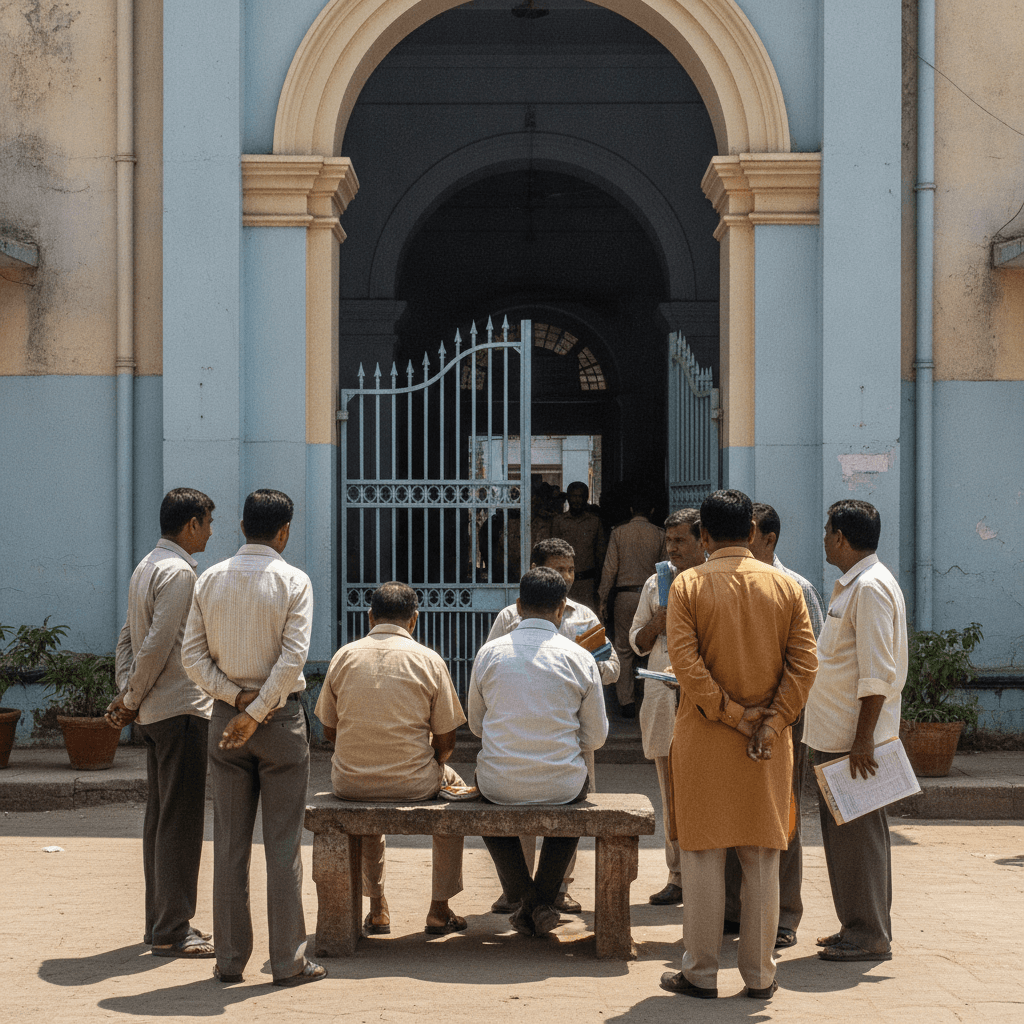
Karnataka High Court Flags Police Interference in Civil Disputes
A bench of the Karnataka High Court has raised alarm over excessive and systemic police involvement in civil disputes, observing that the daily listing of 10 to 15 General Miscellaneous Police matters indicates a deeper problem requiring urgent judicial intervention.
Justice C.M Poonacha, hearing cases involving police interference in civil disputes judgements, remarked that such a volume signals something fundamentally wrong with how law enforcement agencies approach their jurisdiction. The court's concern centers on the blurring of boundaries between civil and criminal matters, a distinction that has long been central to India's legal framework but increasingly appears to be eroding in practice.
"If there are 10-15 General Miscellaneous Police matters listed on a day, it definitely means something is wrong," Justice Poonacha observed from the bench. The comment reflects growing judicial frustration with a pattern in which police departments intervene in disputes that are properly civil in nature—matters between private parties over contracts, property, family arrangements, or commercial transactions—rather than genuine criminal offences involving public order or harm.
The court's observation suggests the judiciary is moving toward establishing clearer demarcation between civil and criminal jurisdiction. Such a step would directly address a persistent problem: citizens filing police complaints in civil disputes, police registering cases without proper scrutiny, and courts subsequently burdened with cases that should never have entered the criminal system.
Systemic Confusion Over Police Powers
The root of the problem lies partly in public misunderstanding and partly in police practice. Many citizens, when faced with civil disputes—a neighbour's boundary encroachment, a landlord-tenant disagreement, a contract breach—approach the police first. Police stations, in turn, sometimes register cases under criminal provisions that can technically apply to civil situations, such as criminal intimidation, criminal breach of trust, or cheating. Once registered, these cases clog the criminal courts and divert investigative resources from genuine criminal matters.
The Supreme Court has previously recognized this issue. In Sayad Asifulla v. State of Karnataka, decided in August 2026, the Supreme Court clarified that victims of human rights violations have two separate mechanisms available under the Protection of Human Rights Act, 1993, and that confusion between these routes can delay justice. The judgment emphasized that the wrong procedural path should not defeat substantive rights, a principle that applies equally to the civil-criminal divide.
Justice Poonacha's remarks suggest the Karnataka High Court is now preparing to address this at a systemic level rather than case-by-case. The court appears to be considering guidelines or rules that would require police to screen complaints more carefully before registering cases, or that would empower magistrates to summarily reject police cases that are patently civil in nature.
Impact on Citizens and Civil Rights
The practical consequence of unchecked police interference in civil disputes is severe. A citizen involved in a genuine civil dispute—say, a business partner refusing to return invested capital—may find themselves facing a criminal investigation, arrest, and criminal trial lasting years, even though the matter should be resolved through civil courts, arbitration, or mediation. The criminal stigma attaches regardless of eventual acquittal. Conversely, the genuine civil claimant may be frustrated by the parallel criminal case, which often delays civil remedies.
Furthermore, police interference in civil matters diverts investigative capacity from serious crimes. A police station stretched thin investigating civil complaints has fewer resources for robbery, assault, sexual offences, and other matters that genuinely require criminal investigation.
The court's concern also touches on constitutional protections. Citizens have a right to have their civil disputes resolved through proper civil procedures, with due process safeguards designed for civil litigation. When police and criminal courts become the forum for civil disputes, those safeguards are often inadequate. For instance, the burden of proof in criminal cases is beyond reasonable doubt, designed to protect the accused from state overreach in matters of liberty. That standard is inappropriate for deciding whether a contract was breached or a property boundary was correctly drawn.
Toward Clearer Judicial Guidelines
Justice Poonacha's observation strongly suggests that the Karnataka High Court intends to issue guidelines or rules addressing police interference in civil disputes circular Karnataka matters. Such guidance could take several forms: a direction that police must obtain permission from a magistrate before registering cases in specified civil categories; a requirement that police provide written reasons for registering a case that appears civil in nature; or a standing instruction that civil courts should summarily reject cases that should have been filed civilly.
Other high courts have taken similar steps. The Delhi High Court has periodically reminded police that matrimonial disputes, property boundary disagreements, and contract disputes are not matters for criminal investigation absent a genuine criminal element such as fraud or violence. The Bombay High Court has issued similar directions.
A consistent, court-backed rule across Karnataka would provide clarity to both police and the public. Citizens would know to approach civil courts first for civil disputes. Police would have clear authority to refuse or reject complaints that do not involve criminal conduct. Magistrates would have explicit guidance on screening cases at the first information report stage.
Broader Legal Context
The distinction between civil and criminal matters is not new to Indian law. The Indian Penal Code, 1860, and the Criminal Procedure Code, 1973, contemplate a criminal justice system designed for violations of public order and law. The Indian Contract Act, 1872, the Transfer of Property Act, 1882, and other civil statutes provide remedies for private disputes. The two systems have different procedural rules, different standards of proof, and different remedies.
Yet in practice, the boundary has become porous. A contract dispute can be framed as cheating under Section 415 of the IPC. A property disagreement can become criminal intimidation under Section 503. A family dispute can become cruelty or criminal intimidation. Once framed criminally, the case enters the criminal system, and civil courts often defer or decline jurisdiction on the grounds that a criminal case is pending.
Justice Poonacha's concern is that this erosion of boundaries has become systematic. The presence of 10-15 such cases daily in a single High Court suggests the problem is not occasional or isolated but reflects a pattern across the state's police force.
Next Steps and Practical Effect
The court's remarks are likely to prompt action. The Karnataka High Court may issue a formal circular or rule within the coming months, possibly in consultation with the state's police department and magistracy. Such guidance would then filter down to police stations and lower courts, establishing a clearer protocol for handling complaints that appear civil in nature.
For lawyers and citizens, the implication is clear: civil disputes should be pursued through civil courts, arbitration, or mediation, not through police complaints. For police, the message is equally plain: screening complaints carefully and refusing to register cases that lack a criminal element is not an infringement of a citizen's right to complain but a proper exercise of discretion to protect the integrity of the criminal justice system.
The court's observation reflects a mature understanding that access to justice requires not just open courthouse doors but also doors that lead to the right forum. Justice Poonacha's concern suggests that the Karnataka High Court is committed to ensuring that police interference in civil disputes judgements does not continue unchecked, and that clearer lines between civil and criminal jurisdiction will soon be drawn.
Comments
Sign in to read the discussion and share your thoughts.
Latest from LawWorld
News
View all- Supreme Court Refers SARFAESI Priority Dispute With Depositor Law To Larger Bench27 Nov 2026
- Supreme Court Rules Mere Objections In Protest Petition Are Not A Complaint27 Nov 2026
- Supreme Court Quashes Bihar Remission To Anand Mohan In IAS Officer Murder Case27 Nov 2026
- Supreme Court Acquits Rape Accused For Lack Of Medical Evidence27 Nov 2026
- Supreme Court Mandates Separate Hexagonal Warnings For Fat, Sugar, Salt26 Nov 2026