
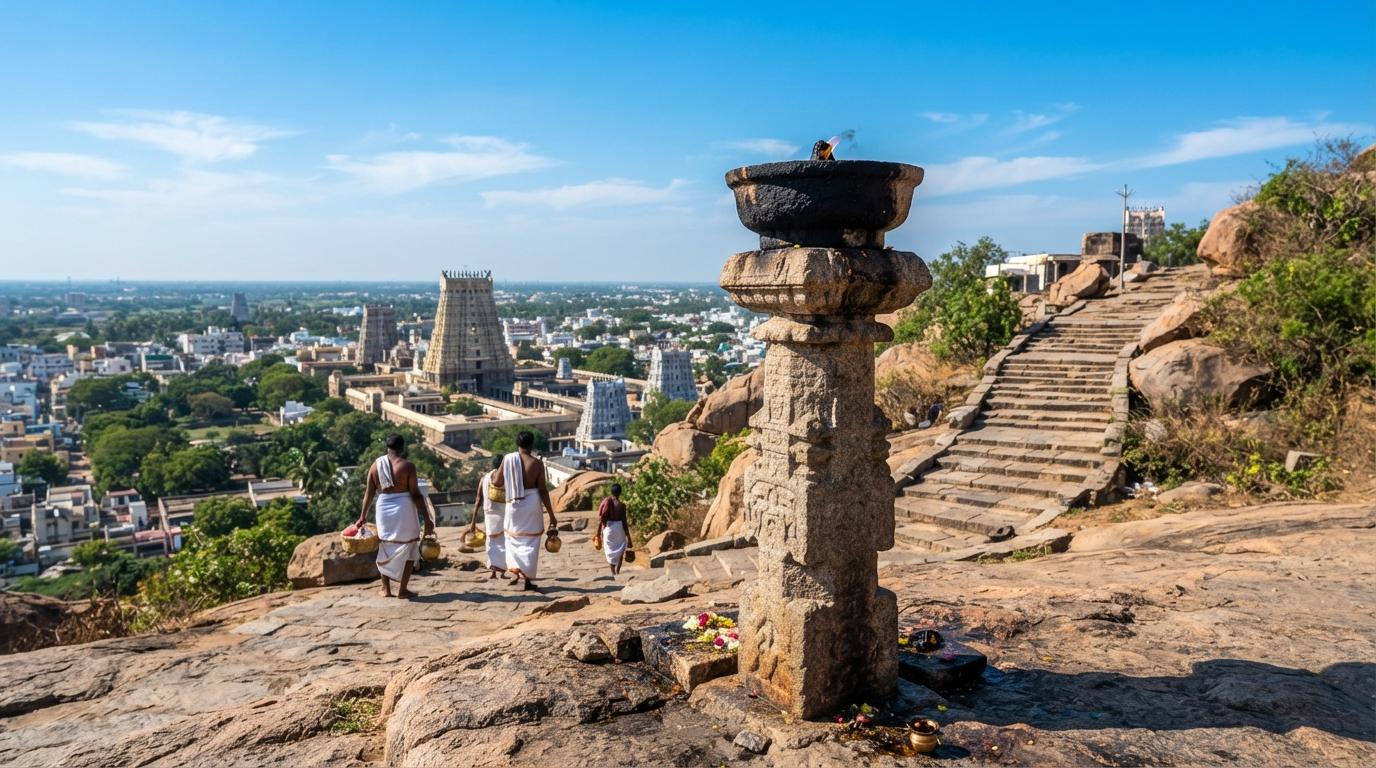
The State of Tamil Nadu, through the Commissioner of the Hindu Religious and Charitable Endowments Department, filed a review petition in Supreme Court on November 23, 2026 against the interim order dated November 20, 2026. The order had permitted a limited team of the Arulmigu Subramaniya Swamy Temple to light the ceremonial Karthigai Deepam 2026 at the stone pillar known as Deepathoon atop Thirupparankundram Hill in Madurai on November 24, 2026 as a one-time measure for this year alone. The same order had stayed the findings in the Madras High Court judgment so far as they concerned the challenge in the present proceedings.
Filed under Article 32 of the Constitution, the underlying petition had sought a writ of mandamus to the Archaeological Survey of India to take over the entire Thirupparankundram Temple and to keep a lamp lit atop the Deepathoon pillar permanently for 24 hours daily. The Court had issued notice on that plea in January 2026. Notice was also issued in a separate plea against the Division Bench order of the Madras High Court confirming the single judge's order that had allowed lighting of the lamp on the stone pillar on the lower peak of the hillock.
The interim order was passed by a Bench comprising Justice Aravind Kumar and Justice Vipul M. Pancholi. The Bench said the matters raised several questions of considerable importance, including the nature and extent of religious freedom, the enforceability of an asserted religious practice, the authority of the temple administration in matters of religious observance, the effect of earlier judicial pronouncements and the permissible limits of judicial intervention in such matters. The order recorded that broader questions on the scope of Articles 25 and 26 of the Constitution were presently awaiting authoritative pronouncement by a Nine-Judge Constitution Bench in the reference arising from the Sabarimala proceedings.
Declining to examine the merits at the interlocutory stage, the Bench recorded that its decision not to address the submissions made at the Bar must not be understood as either their acceptance or rejection. It took note that both the Single Judge and the Division Bench of the High Court had directed lighting of the ceremonial lamp at the Deepathoon, albeit with differing safeguards and qualifications. That circumstance was not altogether without significance for the limited purpose of considering interim relief, the Supreme Court said. It clarified the observation shall not be construed as approval of the reasoning or findings in either judgment.
One-time arrangement with safeguards
Guided primarily by the proximity of the Karthigai Deepam festival, the Bench held that the opportunity to perform the ceremony on that particular day, if denied, cannot be restored by any subsequent adjudication. It was conscious that performance of the ceremony, once permitted, cannot be undone. A limited, one-time arrangement with stringent safeguards would balance the interests involved pending further consideration, it said.
For the ceremony, the Court directed that the composition and number of the authorised team would be settled by the District Collector, Madurai, in consultation with the Temple Executive Officer, the Archaeological Survey of India and the Commissioner of Police, Madurai. The District Collector was designated as the nodal officer for compliance. The Union of India was directed to examine and facilitate deployment of the Central Reserve Police Force, if sought by the State.
The Bench directed that no member of the general public shall accompany the authorised team to the Deepathoon. It further directed that no procession, public congregation, demonstration, slogan-raising or activity extraneous to the ceremonial lighting of the lamp shall be permitted at the site.
In the review petition, those directions and the stay of the High Court findings are placed before the Court for reconsideration before the scheduled lighting.
Comments
Sign in to read the discussion and share your thoughts.
Latest from LawWorld
News
View all- Supreme Court Refers SARFAESI Priority Dispute With Depositor Law To Larger Bench27 Nov 2026
- Supreme Court Rules Mere Objections In Protest Petition Are Not A Complaint27 Nov 2026
- Supreme Court Quashes Bihar Remission To Anand Mohan In IAS Officer Murder Case27 Nov 2026
- Supreme Court Acquits Rape Accused For Lack Of Medical Evidence27 Nov 2026
- Supreme Court Mandates Separate Hexagonal Warnings For Fat, Sugar, Salt26 Nov 2026