
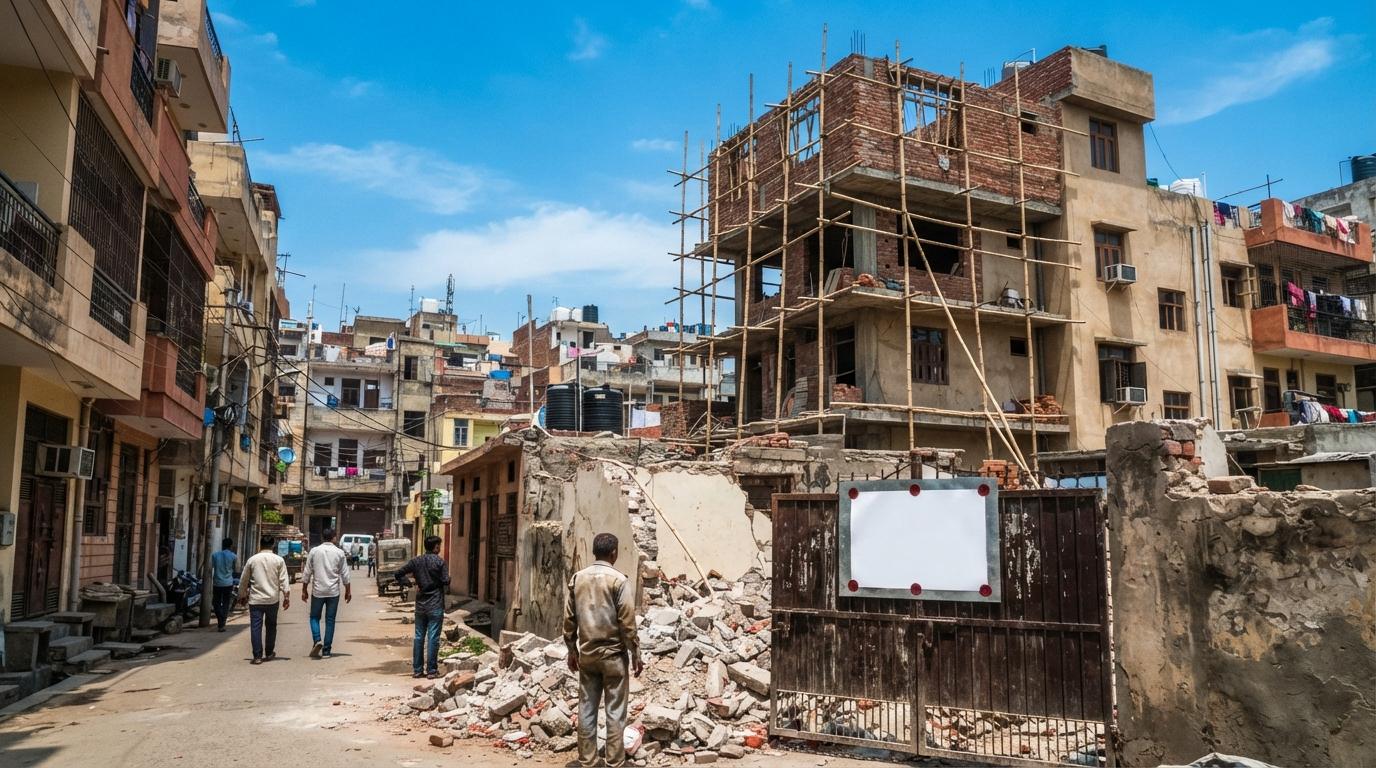
The Supreme Court bench of Justices B V Nagarathna and Sanjeev Sachdeva on Monday said it was not practical to examine illegal construction and violation of building bye laws across the country in a suo motu petition.
With that, all pending applications by persons aggrieved by demolition orders or civic inaction were disposed of, with liberty to approach the high courts, tribunals or municipal authorities concerned.
Transfer after blanket demolition orders
Monday's was the first hearing before the present bench after Chief Justice of India Surya Kant withdrew the matter from the bench headed by Justice Ahsanuddin Amanullah last week.
As the order records, the Justice Amanullah bench did not hold the public interest litigation roster.
On March 25, while hearing a Tamil Nadu case involving violation of a sanctioned plan by one individual, that bench converted the dispute into a pan-India matter.
Blanket directions followed for demolition and sealing of unauthorised constructions and misuse of residential premises in capital cities of all states and Union territories.
The Tamil Nadu matter itself, the order notes, had long been dismissed.
Why bench circumscribed case
Continuing the case by impleading municipal corporations of the capital cities of all states and Union territories as respondents posed a practical difficulty, the bench said.
Every state and Union territory has its own municipal law and by-laws governing construction of buildings, it noted.
A public interest petition could not be turned into private litigation between two parties, the bench said.
Nor was it practical to pass common orders for all states and Union territories, or feasible to examine breach of building by-laws in construction or repairs on a case-to-case basis for each state.
Pan-India monitoring, the bench said, had led to a proliferation of applications before it.
There were instances, it noted, where people were "crying on the road" because officials disregarded stay orders granted by high courts in view of the Supreme Court's order.
"Shortly put, the compass of the matter would have to be circumscribed," the bench said.
Illegal constructions flourish with the connivance of municipal authorities, it observed.
Such construction damages urban infrastructure, the bench said.
Affidavits have now been called for from state governments on enforcement of building regulations.
The matter will now be taken up on January 6, 2027.
Comments
Sign in to read the discussion and share your thoughts.
Latest from LawWorld
News
View all- Supreme Court Refers SARFAESI Priority Dispute With Depositor Law To Larger Bench27 Nov 2026
- Supreme Court Rules Mere Objections In Protest Petition Are Not A Complaint27 Nov 2026
- Supreme Court Quashes Bihar Remission To Anand Mohan In IAS Officer Murder Case27 Nov 2026
- Supreme Court Acquits Rape Accused For Lack Of Medical Evidence27 Nov 2026
- Supreme Court Mandates Separate Hexagonal Warnings For Fat, Sugar, Salt26 Nov 2026