
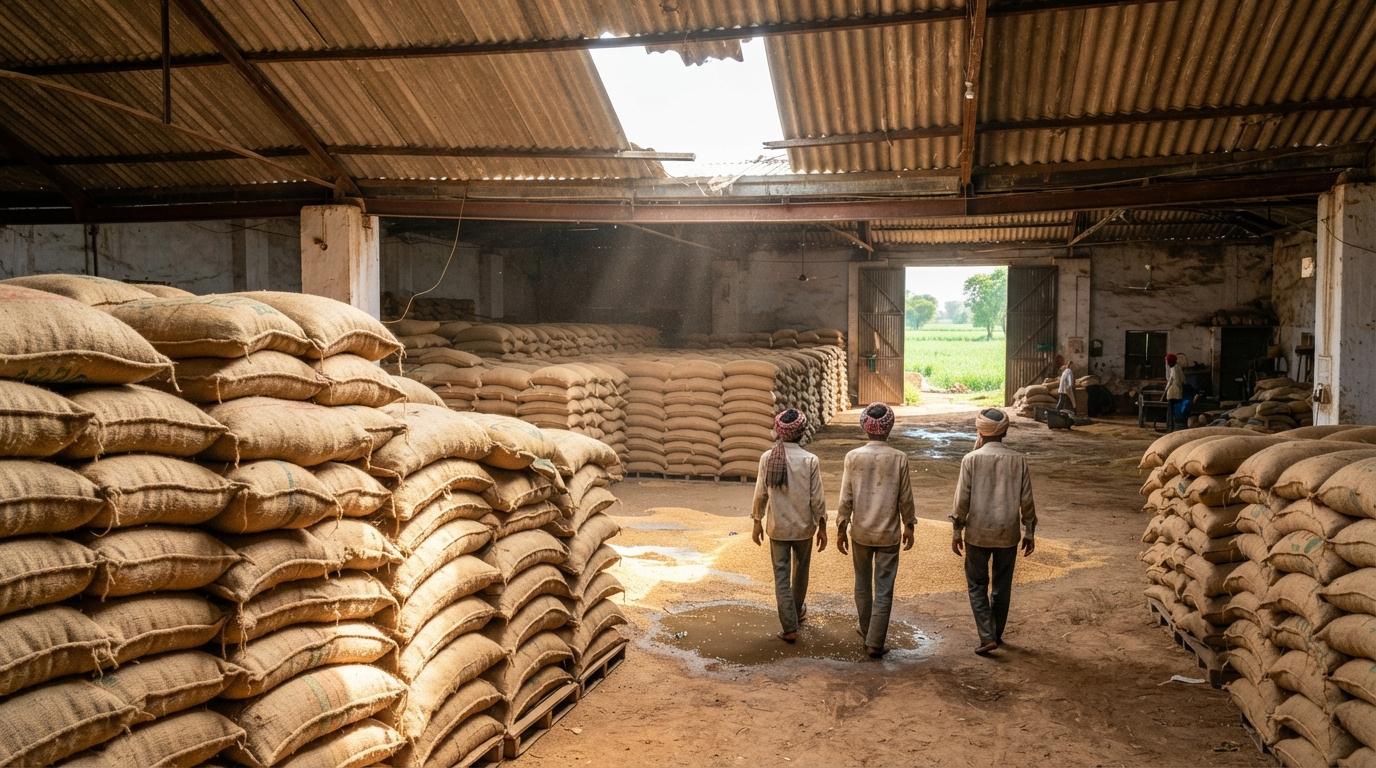
Farm produce kept in a warehouse for storage charges is bailment, not trust property. The Supreme Court said so on November 26, 2026, when Justice Ujjal Bhuyan and Justice Atul S. Chandurkar decided Ramsakhi Gupta vs ICICI Lombard General Insurance. The bench held such storage is bailment under Section 148 of the Indian Contract Act, 1872, and the insurer remained liable for storm damage to the stock.
M/s Nikhra Warehouse at Dabra in Madhya Pradesh, run by the appellant as proprietor, stored agricultural produce belonging to farmers for consideration, the judgment records. That produce stood hypothecated to the State Bank of India, and cover had been taken from ICICI Lombard General Insurance Co. Ltd. for the warehouse building and the stock kept inside. Farmers were bailors and the warehouse owner bailee in a commercial arrangement, the bench said, not parties to a trustee-beneficiary relationship.
Hailstorm broke roof, stock damaged
A hailstorm on 13 March 2007, followed by heavy rain, broke the asbestos roof and let water in, damaging a large quantity of stored produce, the order records. Loss to stock was assessed at Rs. 36,83,955 and damage to the building at Rs. 6,41,268 by local revenue authorities and the appellant's valuer. The insurer's surveyor accepted the structural damage but rejected the produce claim, saying farmer-owned goods were "goods held in trust" excluded under General Exclusion Clause 5.
In Madhya Pradesh, the State Consumer Disputes Redressal Commission allowed the complaint and awarded Rs. 43,25,223 with interest. The National Consumer Disputes Redressal Commission reversed that order, holding third-party-owned stock was not covered. The warehouse owner then appealed to the Supreme Court.
A policy must be read as a whole, the bench said, and an exclusion cannot be lifted out of context. Exclusion clauses are construed narrowly, while coverage clauses take a broader reading tied to the commercial purpose of the contract. Ownership by someone other than the insured does not by itself bring goods within the exclusion, the Court said, and the insurer had to prove the goods actually fell under it.
Farmers had paid storage charges and the warehouse keeper retained possession for a specific purpose, the Court noted on the facts, which satisfied the test of bailment in Indian Contract Act. A harmonious reading was required of the schedule, the declared stock value, the hypothecation details and the Agreed Bank Clause in favour of the bank, the judgment said. The policy insured stored stock up to Rs. 1.5 crores, though the insurer knew at issuance that the goods belonged to farmers and stood hypothecated.
A bailee holds a legally recognised insurable interest in custody goods even where ownership stays with third parties, the Court held. The cover over the stored stock was therefore valid and enforceable against the insurer for the rain damage.
Comments
Sign in to read the discussion and share your thoughts.
Latest from LawWorld
News
View all- Supreme Court Disposes Sucheta Dalal PIL On Unclaimed Financial Assets27 Nov 2026
- Supreme Court Upholds Five-Year Debarment Of Road Firms In Meghalaya Highway Graft Case27 Nov 2026
- Supreme Court Refers SARFAESI Priority Dispute With Depositor Law To Larger Bench27 Nov 2026
- Supreme Court Rules Mere Objections In Protest Petition Are Not A Complaint27 Nov 2026
- Supreme Court Quashes Bihar Remission To Anand Mohan In IAS Officer Murder Case27 Nov 2026