
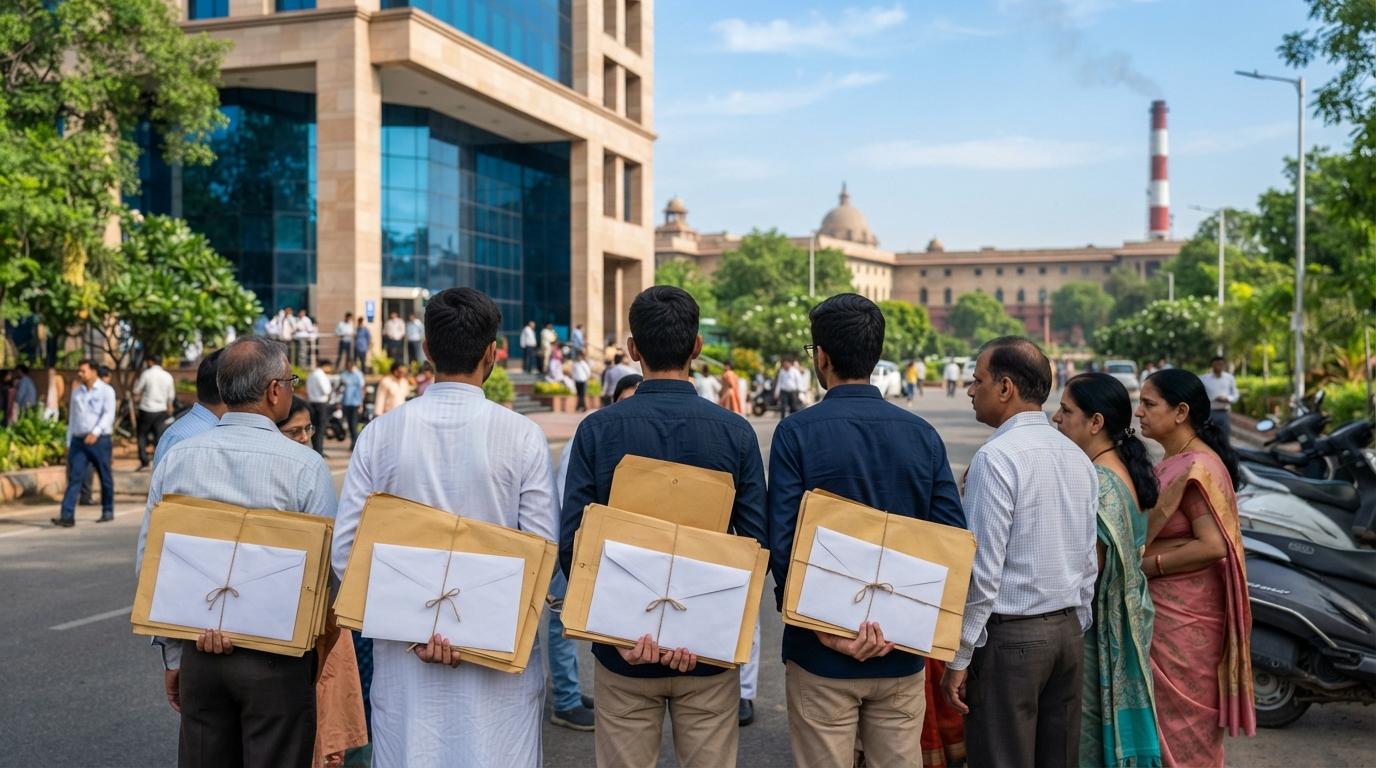
Justice Pamidighantam Sri Narasimha and Justice R. Mahadevan disposed of miscellaneous applications clarifying the temporal operation of the March 11, 2026 ruling on creamy-layer determination for OBC candidates whose parents are employed in public sector undertakings, banks and other organisations. The respondents and intervenors are entitled to reservation benefits and consequential placement under that ruling. Their relief will not affect the seniority of others. Selections and appointments already concluded will not be reopened.
All selections, appointments and allotments made after that date concerning reservation implementation and creamy-layer exclusion will be governed by O.M. No.36012/22/93-Estt (SCT) dated September 8, 1993 as interpreted by the Court. For the Civil Services Examination, 2025, where service allocation was pending, allocation of services to OBC candidates must follow the creamy-layer principle as interpreted in the ruling. The government remains at liberty to formulate its policy on reservation and creamy-layer criteria.
The applications had sought permission to finalise service allocation to candidates recommended by the Union Public Service Commission in CSE-2025 on the basis of the principles for determination of OBC creamy-layer status applied before the March ruling. Solicitor General Tushar Mehta appeared for the appellants, while Senior Advocate Basavaprabhu Patil appeared for the respondents.
Income test led to dispute
The Income/Wealth Test under Category VI of the 1993 office memorandum read with clarificatory letter No. 36033/5/2004-Estt.(Res.) dated October 14, 2004 was applied by the Department of Personnel and Training because equivalence of posts in public sector undertakings, banks and other organisations vis-a-vis government posts had not been formally determined. On assessment of parental income for the preceding three financial years, the department treated the respondents, whose parents worked in PSUs, as falling within the creamy layer of OBC and withheld service allocation under the reserved category. The candidates moved the Central Administrative Tribunal and secured orders in their favour.
Writ petitions by the department challenging those orders were dismissed by the High Courts of Madras, Delhi and Kerala. The department then filed civil appeals before the top court, while other successful civil services candidates of different years whose applications, representations or proceedings were pending before the department, the Tribunal or the High Courts intervened seeking relief. The top court dismissed the civil appeals and ordered consideration of the claims of the respondents and intervenors in line with the principles declared, for implementation within six months.
In the clarification order, the Bench said, "It is also well settled that miscellaneous applications cannot be employed as a means to seek a rehearing of matters already decided or to reopen issues concluded by the judgment. Such applications may be entertained only for the correction of clerical or arithmetical errors or the resolution of genuine difficulties in implementing the directions issued by the Court." The order records that the present applications were entertained only to clarify the scope and temporal operation of the directions already issued and could not be employed as a ruse to secure reconsideration of the merits under the guise of seeking clarification. The Bench explained that reopening a concluded selection process after a substantial interval may prejudice numerous other persons and disrupt successive stages of service administration. It observed that retrospective application of the principle may also unsettle promotions already granted and disturb settled service positions.
Comments
Sign in to read the discussion and share your thoughts.
Latest from LawWorld
News
View all- Supreme Court Bars Customs Refund Without Challenge to Self-Assessment15 Nov 2026
- Karnataka High Court Restores GST Appeal Dismissed for 226-Day Delay15 Nov 2026
- Karnataka High Court Holds Adulterer Is Proper But Not Necessary Party in Divorce Plea15 Nov 2026
- Karnataka High Court Quashes SC/ST Act Complaint Against Bharat Forge Chairman Over 11-Year Delay15 Nov 2026
- Karnataka High Court Directs Review of Mental Health Policies for Armed Personnel While Quashing Suicide-Attempt Case15 Nov 2026
Articles
View all- Article 22(2) Clock Starts at Curtailment of Liberty, Not Formal Arrest: Supreme Court in NDPS Bail Case15 Nov 2026
- Supreme Court Upholds Bihar Special Intensive Revision of Electoral Rolls14 Nov 2026
- Seven-Judge Constitution Bench Holds Decades-Old State Sales Tax Surcharge Reference Academic After GST6 Nov 2026