
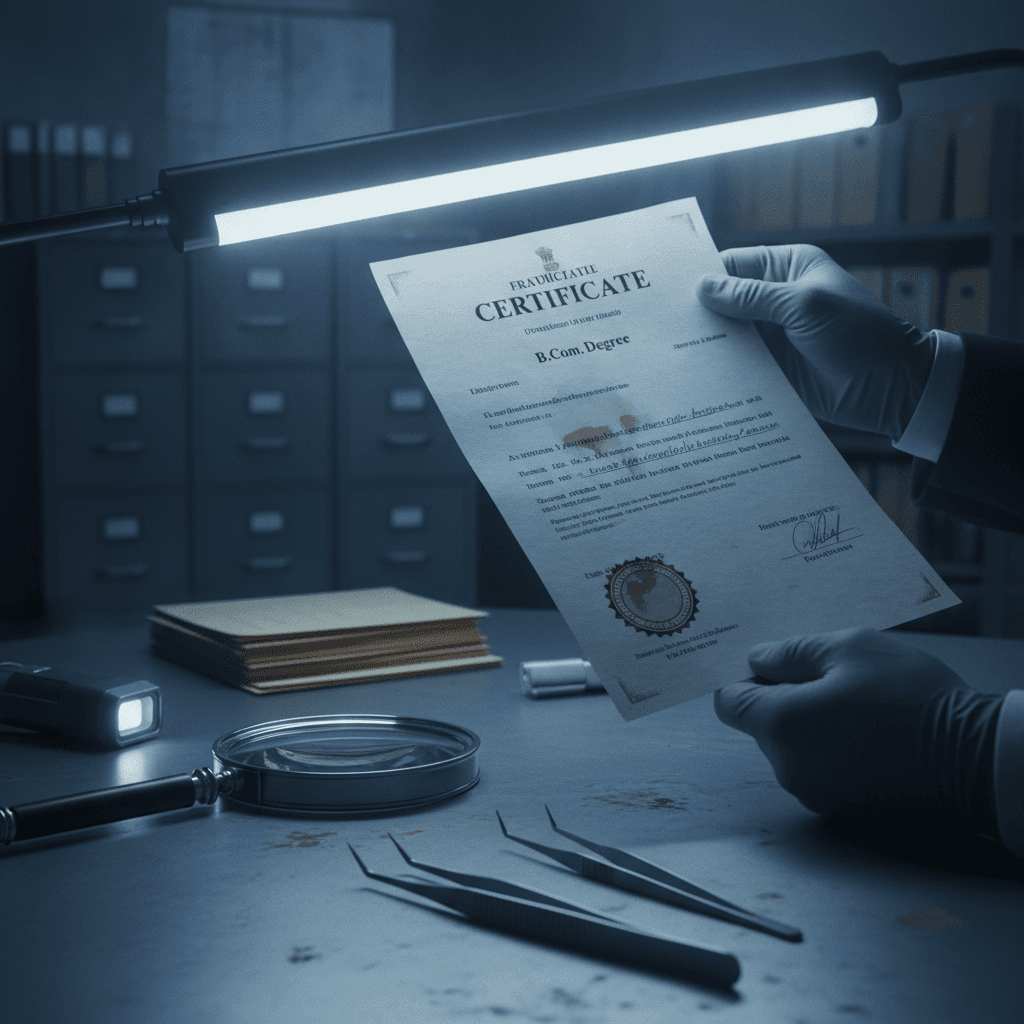
Supreme Court of India Records CBI Finding of Fraudulent Advocate Degree; Fresh Questions on Bar Council Verification Standards
The Supreme Court of India has recorded a Central Bureau of Investigation finding that an advocate's B.Com degree is prima facie fake, according to a Hindi-language report framing the matter as manipulation of government records in a degree case. While the individual case details remain confined to court proceedings, the incident has surfaced a systemic vulnerability that has long concerned the legal profession: the adequacy of credential-verification mechanisms at State Bar Councils and the potential for fraudulent enrolment to undermine confidence in the entire advocate community.
Enrolment as an advocate under the Advocates Act, 1961, rests fundamentally on proof of genuine academic qualifications. The statutory requirement is non-negotiable. Yet across India's legal profession, there has been growing anxiety that a small but non-negligible number of practitioners may have entered the roll through forged or manipulated educational certificates. Each such case, when exposed, casts a shadow over thousands of properly qualified and ethically enrolled advocates. The Supreme Court's acknowledgment of the CBI finding in this instance brings the problem into sharp judicial focus and raises urgent questions about what State Bar Councils must do to prevent similar frauds.
The Role of State Bar Councils in Credential Verification
State Bar Councils across India are statutorily responsible for maintaining the roll of advocates and verifying the qualifications of applicants seeking enrolment. The Bar Council of India, as the apex regulatory body, sets standards and guidelines; State Councils implement them at the ground level. In theory, this two-tier structure should act as a robust filter against fraudulent credentials. In practice, however, the process has historically relied on documentary submission and cursory cross-checks rather than rigorous, independent verification with educational institutions.
Several State Bar Councils have launched credential-verification drives in recent years, prompted by sporadic exposures of fake degrees and forged certificates. These initiatives typically involve direct contact with universities and colleges to confirm that a given degree was genuinely awarded to a named individual. Some councils have begun digitizing records and cross-referencing them with university databases. Yet the pace and consistency of such verification remains uneven across states, and many councils still operate on a complaint-driven rather than proactive basis.
The Supreme Court's recording of the CBI finding in this case implicitly signals that judicial oversight of professional standards is alive. It also suggests that where suspicion of fraud arises—whether through complaint, investigation, or audit—courts will not shy from acknowledging investigative conclusions and creating a record that may inform future regulatory action.
Implications for Ongoing Matters and Client Rights
One of the most vexing practical questions raised by fraudulent enrolment is the status of legal work conducted by an advocate whose credentials are later discovered to be fake. If an advocate has represented clients, drafted documents, appeared in court, or provided legal advice while operating under a forged degree, what becomes of those transactions?
Indian law does not yet have a comprehensive, codified answer. Courts have grappled with this issue on a case-by-case basis. In some instances, judges have held that work done by an unqualified or fraudulently enrolled person may be voidable but not automatically void, particularly if the client received genuine legal assistance and suffered no prejudice. In other cases, courts have emphasized that the integrity of the profession demands that any matter touched by a fraudulently enrolled advocate should be re-examined and, if necessary, re-done by a qualified practitioner.
Clients who discover that their advocate was not genuinely qualified face a difficult position. They may have paid fees for services they believed were being rendered by a licensed professional. If the advocate's enrolment is cancelled and the person is struck off the roll, the client's remedies are limited. They may pursue civil claims for recovery of fees or damages, but such suits are slow and uncertain. They may also petition the Bar Council for disciplinary action, though that body's primary role is regulation of the profession, not compensation of clients.
The Supreme Court of India and High Courts have occasionally intervened to protect clients' interests in such situations, directing re-hearing of matters or providing other relief. But without a clear statutory framework, consistency cannot be assured. The incident now recorded in the Supreme Court's case file may prompt calls for clearer guidelines on how courts and regulators should handle the aftermath of discovered fraudulent enrolment.
Systemic Vulnerabilities and Regulatory Response
The existence of even a handful of fraudulently enrolled advocates reflects systemic weaknesses that extend beyond any individual State Bar Council. First, the initial verification process at enrolment remains largely manual and document-dependent. A determined fraudster with access to forged certificates can still slip through, especially if the Bar Council does not independently contact the issuing institution. Second, there is no centralized, real-time database of all advocates enrolled across India's State Councils, making it difficult to detect if a person has been enrolled in multiple states or under different names. Third, periodic re-verification of active practitioners is not mandated, so once an advocate is enrolled, their credentials may never be checked again.
The Bar Council of India has issued circulars and guidelines urging State Councils to strengthen verification protocols. Some councils have responded by implementing online verification systems, requiring affidavits from educational institutions, or conducting spot checks of degree certificates against university records. Yet these measures are not uniform, and their effectiveness depends on the resources and commitment available to each State Council.
The Supreme Court's acknowledgment of the CBI investigation in this case may serve as a catalyst for more rigorous regulatory action. It demonstrates that investigative agencies and courts take credential fraud seriously and will not treat it as a minor administrative matter. This message, filtered through legal networks and bar associations, may encourage State Councils to invest further in verification infrastructure and to treat credential checks as a priority rather than a routine formality.
Professional Standards and Public Trust
At its heart, the issue is one of professional integrity and public trust. The legal profession in India enjoys a position of considerable privilege and responsibility. Advocates are officers of the court, entrusted with clients' most sensitive affairs and often wielding significant influence in dispute resolution and policy advocacy. The public's confidence in the profession rests partly on the assumption that anyone holding the title "advocate" has genuinely earned the qualifications that the law requires.
When fraudulent enrolment occurs, it breaches that trust. It also unfairly tarnishes the reputation of the vast majority of advocates who have honestly obtained their degrees, completed their articles, and met all statutory requirements. Bar associations and individual advocates have a collective interest in rooting out fraud and demonstrating that the profession polices itself rigorously.
The Supreme Court of India's recording of the CBI finding is a public acknowledgment that such fraud can and does occur, and that judicial and investigative authorities will take it seriously. For State Bar Councils, it is a signal to accelerate credential verification and to treat applications with appropriate skepticism. For clients and the public, it reinforces the importance of verifying an advocate's credentials independently before engaging their services.
As the legal profession in India continues to grow and evolve, maintaining rigorous standards of enrolment and ongoing professional conduct will remain essential to sustaining public confidence and the rule of law.
Comments
Sign in to read the discussion and share your thoughts.