
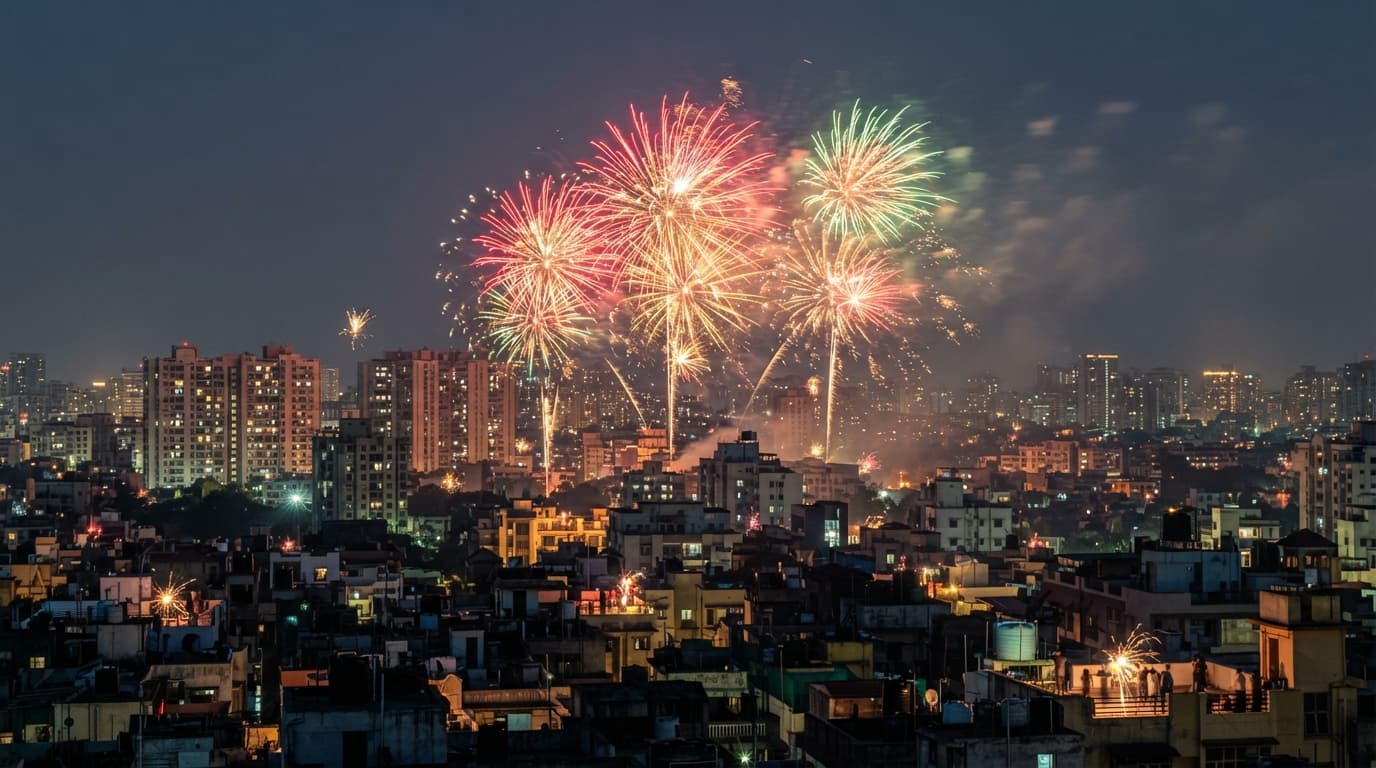
The Supreme Court of India has indicated that firecrackers during Diwali may be permitted only within specified time windows, striking a middle ground between those seeking an outright ban and those demanding unrestricted use. A bench of Justices M.M. Sundresh and Prasanna B. Varale made clear that any regulatory framework must balance religious and cultural sentiments with serious concerns over air and noise pollution, particularly the impact on vulnerable populations.
This approach rejects both extremes: a complete prohibition on firecrackers during the festival and the absence of any regulation whatsoever. Instead, the court has signalled its preference for a time-bound regulatory model that acknowledges the cultural significance of Diwali celebrations while addressing the documented health and environmental harms caused by unchecked firecracker use.
Expert Report on Barium-Based Firecrackers
The bench sought a report from the Central Pollution Control Board (CPCB) specifically on barium-based firecrackers, indicating that the court recognises different types of firecrackers may pose varying levels of risk. This request suggests the court intends to base its eventual order on scientific evidence rather than broad assumptions. The CPCB, as the apex environmental regulator under the Ministry of Environment, Forest and Climate Change, is the appropriate body to provide technical data on the composition of firecrackers and their measurable impact on air quality and public health.
Barium compounds are commonly used in firecrackers to produce colour in explosions. The court's specific interest in these substances signals awareness that not all firecracker materials carry identical pollution profiles. By requesting detailed information from the CPCB, the bench is laying groundwork for a differentiated regulatory approach that may permit certain types of firecrackers while restricting others, or alternatively, permit all types only during designated hours when exposure can be minimised.
Protecting Vulnerable Populations
The court's concern with vulnerable populations reflects a recognition that firecracker pollution does not affect all citizens equally. Children, elderly persons, individuals with respiratory conditions such as asthma, and those living in densely populated urban areas face disproportionate health risks from air and noise pollution. Delhi and other major Indian cities regularly experience severe air quality degradation during and immediately after Diwali, with particulate matter concentrations rising sharply.
By emphasising the need to consider impact on vulnerable populations, the bench has signalled that public health protection is a central concern in the court's reasoning. This is consistent with the constitutional commitment to the right to life under Article 21 of the Constitution of India, which courts have interpreted to include a right to a healthy environment and clean air.
At the same time, the court has not dismissed the cultural and religious significance of firecrackers in Diwali celebrations. For many communities, bursting firecrackers is an established tradition tied to the festival. The court's willingness to permit firecrackers within specified time windows rather than impose a total ban acknowledges this reality. Such an approach allows celebrations to continue while potentially reducing overall pollution exposure by concentrating firecracker use into limited hours rather than permitting it throughout the day and night.
How Time Windows Work in Practice
The concept of specified time windows for firecrackers is not entirely novel in Indian jurisprudence. Courts have previously imposed restrictions on the timing of celebrations, particularly in densely populated areas. However, the Supreme Court of India's endorsement of this model at the apex level provides clarity and potential uniformity across jurisdictions.
Time-bound regulations offer practical advantages. They allow regulatory authorities to increase monitoring and enforcement during permitted hours. They provide advance notice to residents, enabling those with health vulnerabilities to take precautions such as remaining indoors, using air purifiers, or obtaining medical support in advance. They also allow traffic and emergency services to prepare for increased demand during and after permitted firecracker hours.
The specific hours to be permitted remain undetermined at this stage. Previous orders in various high courts have experimented with different windows, ranging from two hours in the evening to a few hours in the morning and evening. The Supreme Court of India's eventual order will likely need to consider the diversity of Indian geography and climate; time windows suitable for Delhi's winter pollution patterns may differ from those appropriate for coastal or southern regions.
Consolidating Overlapping Cases
The bench noted that there are overlapping proceedings on this issue and suggested that related matters be considered by an appropriate common bench. This observation reflects practical case management concerns. Firecracker regulation has been the subject of multiple petitions before the Supreme Court, High Courts, and National Green Tribunal (NGT). Different benches issuing conflicting orders would create confusion and undermine compliance.
A consolidated approach, heard by a single bench or a specially constituted larger bench, can ensure coherence in reasoning and uniformity in the regulatory framework across India. This is particularly important for matters involving environmental protection and public health, where piecemeal or contradictory orders can be counterproductive.
What Comes Next
The court's approach signals that the judiciary is prepared to craft nuanced solutions to complex policy problems that involve competing fundamental rights and public interests. Neither a blanket ban nor complete freedom serves justice when the interests at stake are this diverse.
The CPCB report, once submitted, will form the evidentiary foundation for the court's final order. The report is likely to include data on pollution levels during Diwali, comparative analysis of different firecracker types, health impacts documented in medical literature, and recommendations for regulatory thresholds or restrictions. This scientific input will allow the court to move beyond generalised assertions to evidence-based regulation.
Regulatory authorities, including state pollution control boards and municipal corporations, will need to prepare enforcement mechanisms once the Supreme Court of India issues its final order. This may involve training personnel to monitor firecracker sales and use, establishing complaint redressal systems, and coordinating with law enforcement for compliance. The time-window model will require clear communication to the public about permitted hours, particularly in multilingual and diverse communities.
The balance struck by the court—permitting firecrackers within specified limits rather than banning them entirely—reflects a mature approach to constitutional governance. It acknowledges that rights are rarely absolute and that the exercise of one person's or community's rights must be reconciled with others' rights and the broader public interest. The court has signalled that a solution exists between the poles of prohibition and unlimited freedom, and that solution involves time-bound, evidence-based regulation that protects vulnerable populations while respecting cultural practices.
The bench's direction to the CPCB and its indication of the regulatory framework to come represent the next phase in this ongoing effort to balance environmental protection with cultural and religious freedom during one of India's most significant festivals.
Comments
Sign in to read the discussion and share your thoughts.
Latest from LawWorld
News
View all- Karnataka High Court Permits Continuation of Corruption Case Against Siddhartha Vihar Trust Despite Lokayukta Closure12 Oct 2026
- Karnataka High Court Quashes Land Acquisition for Housing Project in Bannerghatta National Park, Prioritizes Wildlife Protection12 Oct 2026
- Karnataka High Court Imposes ₹1 Lakh Cost for Inappropriate Plea Against ED Officer Marked to CJI12 Oct 2026
- Karnataka High Court Rules Daughter-in-Law Not Automatically Liable for Mother-in-Law Maintenance After Son's Death12 Oct 2026
- Karnataka High Court Orders Psychological Assessment of Parents in Child Custody Battle12 Oct 2026
Articles
View all- Supreme Court Refers DPDP Act Constitutional Challenge to Five-Judge Bench: RTI vs. Privacy Rights at Stake12 Oct 2026
- Supreme Court Disposes PIL on Doxxing and Deepfakes; Directs Union Ministries to Implement Remedial Measures8 Oct 2026
- Supreme Court Issues Notice on Constitutional Challenge to GST Input Tax Credit Denial Provision7 Oct 2026
Blogs
View all- Supreme Court Orders Priority Hearing for Pension Cases: A Decade-Long Wait Deemed 'Grave Injustice'12 Oct 2026
- Supreme Court Clarifies Gratuity Calculation: Monthly Wages Divided by 26 Working Days, Not 3011 Oct 2026
- Supreme Court Affirms Damages Recovery for Delayed Provident Fund Contributions Without Time Limit10 Oct 2026