
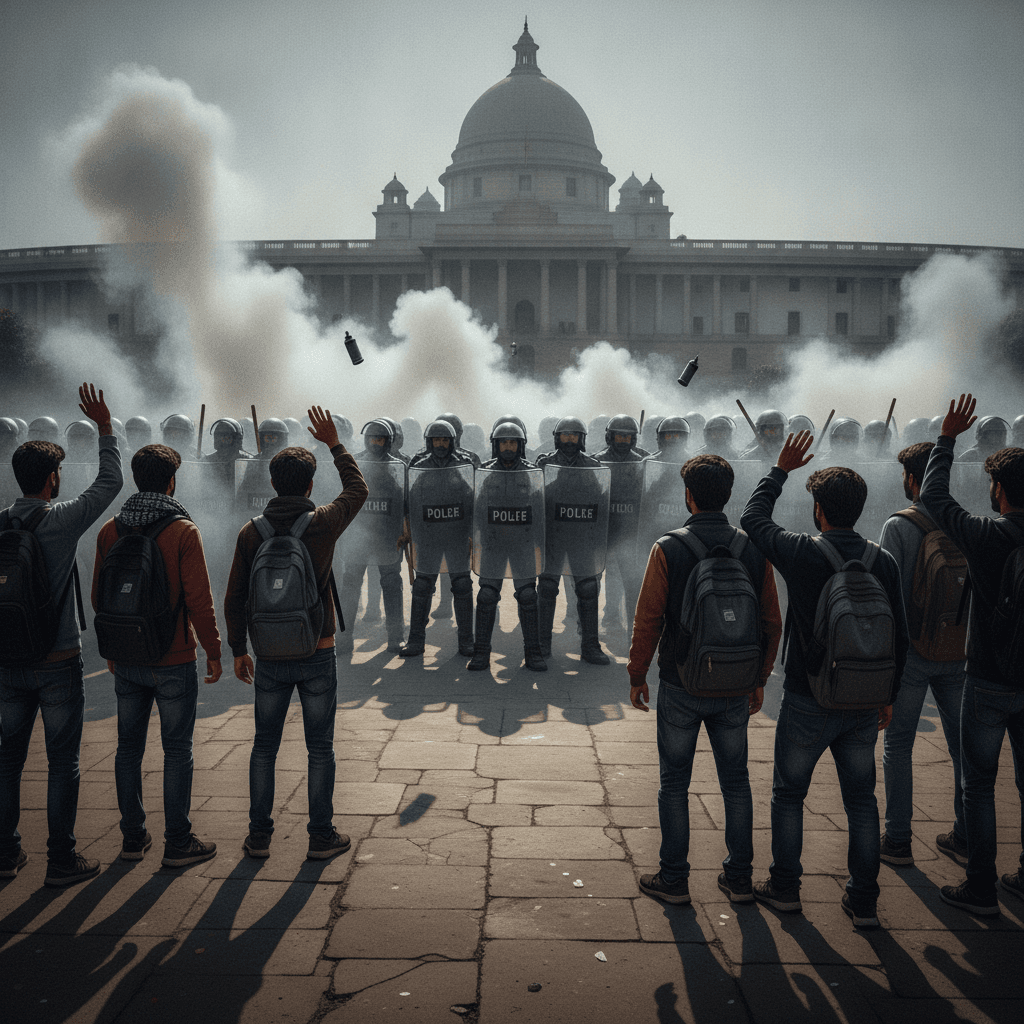
Supreme Court of India Hears Pleas Alleging Police Excesses Against NEET Protesters
The Supreme Court of India is examining two significant petitions that allege widespread police misconduct against students who protested over the National Eligibility cum Entrance Test (NEET) paper leak and related exam irregularities. A bench comprising Chief Justice Surya Kant, Justice Joymalya Bagchi, and Justice V Mohana is presiding over the hearing of these pleas, which represent one of the highest mass-impact stories in the current legal window.
The lead petition, filed as Shailendra Mani Tripathi v. Union of India (Diary no. 44078/2026), arises from a march toward Parliament in which students sought to raise their concerns about the integrity of the national medical entrance examination. The petition alleges that law enforcement personnel employed excessive force against the largely peaceful protesters, including the use of tear gas, baton charges, and mass detentions without adequate legal justification. The plea also raises serious allegations of gender-based misconduct during police operations and the deployment of plainclothes personnel who allegedly engaged in provocative conduct without proper identification or accountability.
According to the petition, approximately 60 protesters sustained injuries during the police action. These injuries reportedly ranged from minor lacerations and contusions to more serious harm requiring medical attention. The scale of injuries and the nature of allegations have drawn significant public attention to questions surrounding police conduct and the constitutional protections afforded to citizens exercising their fundamental right to peaceful assembly and protest.
Constitutional and Legal Framework
The petition challenges the constitutional validity and application of repeated prohibitory orders issued under Section 163 of the Bharatiya Nyaya Sanhita (BNSS), the new criminal procedure code that replaced the Indian Penal Code framework. Section 163 BNSS deals with unlawful assemblies and the power of law enforcement to issue orders restricting public gatherings. The petitioners contend that the manner in which these orders were applied amounted to an unreasonable restriction on the fundamental rights guaranteed under the Constitution of India, particularly Articles 19(1)(b) and 19(1)(c), which protect the rights to assemble peacefully and to form associations, respectively.
The constitutional law of India has long recognized that while the state possesses legitimate authority to regulate public assemblies in the interest of public order and safety, such regulation must be proportionate, non-arbitrary, and subject to judicial scrutiny. The Supreme Court of India has consistently held that the mere fact that a gathering may inconvenience the public or disrupt normal life does not automatically justify police action that violates constitutional protections. The bench hearing these pleas will need to examine whether the police response was calibrated appropriately to any genuine threat posed, or whether it constituted an excessive and unjustified use of force.
Allegations of Misconduct and Accountability
Beyond the immediate use of force, the petition raises serious questions about police accountability and the deployment of plainclothes personnel. The allegation that plainclothes officers participated in police operations raises particular concerns about identification, command structure, and accountability. International standards and Indian constitutional jurisprudence both emphasize the importance of transparency and accountability in law enforcement operations, particularly when force is employed.
The specific mention of gender-based misconduct adds another dimension to the allegations. Women protesters have reported inappropriate conduct by police personnel, raising questions about whether law enforcement protocols include adequate safeguards to prevent abuse and harassment of female protesters. This aspect of the petition touches upon not only constitutional law in India but also statutory protections under the Sexual Harassment of Women at Workplace (Prevention, Prohibition and Redressal) Act and broader principles of human dignity enshrined in the Constitution.
The repeated issuance of prohibitory orders is also significant. If such orders were issued multiple times against the same group of protesters or with respect to the same location, the petition suggests this may have amounted to harassment rather than legitimate regulation of public assembly. The constitutional law of India requires that restrictions on fundamental rights be necessary and proportionate; repeated prohibitions may indicate an attempt to suppress legitimate protest rather than to maintain genuine public order.
NEET Controversy Context
The protests themselves arose from legitimate concerns regarding the integrity of NEET, a critical examination that determines admission to medical colleges across India. Reports of paper leaks and irregularities in the examination process had generated significant concern among students and their families about the fairness and credibility of the selection process. Students undertaking such protests are exercising their right to petition the government and to seek redressal of grievances—activities that are constitutionally protected and socially important in a functioning democracy.
The fact that the protests were directed toward Parliament, the seat of legislative authority, further underscores that the students were engaging in constitutionally protected activity. Petitioning Parliament and drawing legislative attention to concerns about public institutions and their functioning is a core democratic activity. The police response to such activity must therefore be subjected to heightened scrutiny to ensure that it does not amount to suppression of legitimate democratic participation.
Implications for Police Reforms
The petition also seeks implementation of police reforms, a request that carries significant implications for the constitutional law of India and the future conduct of law enforcement. Police reform has been a longstanding concern in Indian jurisprudence. The Supreme Court of India has previously issued directives regarding police functioning, including the Second Administrative Reforms Commission recommendations and various judgments addressing police accountability, training, and conduct.
The current petition provides an opportunity for the Supreme Court to reinforce standards for police conduct during public assemblies and to examine whether existing frameworks for police accountability are adequate. The bench may consider whether additional protocols are needed to ensure that plainclothes operations are properly supervised, that force is used only when necessary and proportionate, and that gender-sensitive procedures are in place to protect all protesters from harassment and abuse.
Procedural and Substantive Issues
As the Supreme Court of India examines these pleas, several key issues emerge. Substantively, the court must determine whether the police actions violated constitutional protections, whether the use of tear gas and baton charges was justified by any genuine threat to public order, and whether the mass detentions complied with procedural requirements under criminal law. Procedurally, the court must consider whether the repeated prohibitory orders were issued in accordance with law and whether adequate notice and opportunity to be heard were provided to the protesters.
The case status in the Supreme Court of India will likely involve detailed examination of evidence, including video footage of the police action, medical records of injured protesters, and testimony from both law enforcement and student representatives. The bench will need to balance the legitimate interests of the state in maintaining public order with the constitutional rights of citizens to assemble and protest.
Broader Constitutional Implications
This hearing carries implications that extend beyond the immediate parties. The case status of the Supreme Court of India in examining these pleas will signal to law enforcement agencies across the country the standards expected when regulating public assemblies. It will also provide guidance on the application of Section 163 BNSS and the scope of restrictions that can be imposed on fundamental rights.
For students and civil society organizations, the outcome may influence the practical ability to organize peaceful protests in the future. For constitutional law scholars and practitioners in India, the judgment will contribute to the evolving jurisprudence on the balance between public order and fundamental rights.
As the Supreme Court of India proceeds with hearing these pleas, the bench will be called upon to uphold both the constitutional protections afforded to citizens and the legitimate needs of law enforcement. The hearing before Chief Justice Surya Kant and his colleagues represents a critical moment for clarifying the boundaries of permissible police conduct and for reinforcing the principle that in India, even when regulating public assembly, the state must operate within constitutional limits and with accountability to the judiciary.
Comments
Sign in to read the discussion and share your thoughts.